Another example of why strong environmental regulations are needed

The chemical spill that fouled West Virginia’s water supply provides yet another example (as if any more were needed) showing why unregulated markets will underinvest in environmental protection.

The Wall Street Journal has a summary here (subscription required)

Freedom Industries Inc., the company connected to a chemical spill that tainted the water supply in West Virginia, on Friday filed for Chapter 11 bankruptcy protection.
A bankruptcy petition signed by the company’s president, Gary Southern, estimates Freedom’s debts at $10 million or less, but the cost of disaster is likely to run much higher.
Thousands of gallons of an allegedly toxic chemical called crude MCHM contaminated the water supply for hundreds of thousands of the state’s residents for days, spawning lawsuits from businesses and people affected by the disaster.

If the company is found liable for damages from the spill, bankruptcy protection prevents the owners from being held fully accountable for damages to others.  The result is that society will end up paying for the costs, so profits have been privatized, and losses socialized.  In addition, companies that behave responsibly and institute best practices  will be penalized by higher costs relative to less responsible companies.

If there are regulations, then everyone in the marketplace has to pay the costs, so no one is disadvantaged.   There can be no clearer argument for why government regulation of environmental damages is needed.  Otherwise there will be a race to the bottom that results in society paying the price.

There are other important issues.  Consider this sentence that occurs later in the WSJ story:

As the chemical isn’t regulated, there are “no published standards” for acceptable levels of concentration in water, according to Freedom.

According to Wired Science, the chemical involved in the spill was

one of 62,000 industrial compounds grandfathered in with passage of the 1976 Toxic Substances Control Act. Basically that meant that no further testing was required; the assumption was that these chemicals, which apparently hadn’t killed anyone yet, were unlikely to do so.

A recent New Yorker story also lays out more details about the lack of oversight, writing

It was, apparently, no one’s job to regularly monitor Freedom Industries’ tanks along the Elk, even though state officials knew that hazardous chemicals were sitting near the West Virginia American Water intake.

This points to fundamental problems with current US regulation of chemicals.  First, many chemicals have been grandfathered, but we have no idea whether these chemicals are toxic or carcinogenic (because no one has an incentive to test them).  Second, we assume that chemicals are safe unless proven otherwise, instead of testing any chemicals before we put them into widespread use.  This assumption leads to greater costs (because manufacturers have to pull products from the shelves if found to be problematic, as they did for BPA in children’s products) but it also will lead to harm that may go undiscovered for years or decade, since the onus is on people with concerns to prove harm, instead of making the chemical companies show safety before putting chemicals on sale.    Finally, the existing regulations on such chemicals are fragmented, incomplete, and often nonexistent, so substantial reforms are needed.

It’s time to change our fundamental assumptions about chemicals, so that all such materials must be tested before they put into products or used for industrial processes.  It’s also time to work through that massive backlog of grandfathered chemicals and figure out which of them are safe and which aren’t, then follow up with appropriate regulations.  And it’s time to make sure all toxic substances are regulated effectively, and that none fall through the cracks.

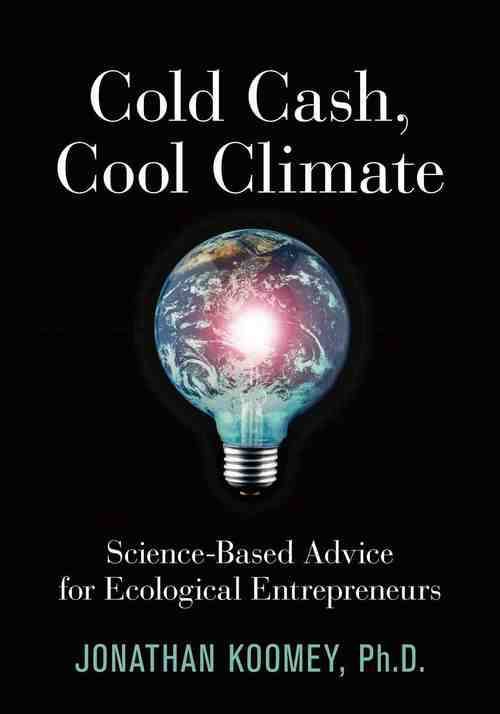
These conclusions imply that we’ll need government action to fix these environmental problems, and that the “government is the problem” crowd will need to be beaten back, yet again.  As I wrote in Cold Cash, Cool Climate (as well as this blog post)

What we need is an honest discussion about what kind of government we want and what we want it to do for us.  Sometimes we’ll want more government, like when we find lead in children’s toys, salmonella in peanut butter, poison in medicines, an unsustainable health care system, or fraudulent assets and a lack of transparency in the financial world.  We know from experience that only government can fix those things. Sometimes we’ll want less government, like when old and conflicting regulations get in the way of starting innovative new companies. Only government can fix that too (although the private sector has some lessons to teach on that score). And sometimes we’ll want the same government, just delivered more efficiently (like the state of California has done with the Department of Motor Vehicles in recent years, the good results of which I’ve experienced firsthand).
When it comes to government, more is not better. Less is not better.  Only better is better. And better is what we as a society should strive for.

It is strange that more than fifty years after Rachel Carson’s Silent Spring, we still haven’t fundamentally reformed how we treat chemicals we put in the environment or in our bodies.  It’s long past time to fix that.

Addendum:  What I’ve suggested above amounts to changing our expectations about property rights, which is a topic I explored in detail in Cold Cash, Cool Climate and in this blog post.  Government defines property rights and those rights can (and should) evolve over time as the economy changes.  There’s nothing radical about making such a change, and doing so in a sensible way would allow society to move towards a more sustainable society with minimal disruption to the economy.  The end result would be a society where the costs of environmental damage are borne more completely by the creators of that damage, which is both efficient and just.

Addendum 2:  Climate Progress gives more examples of how companies can use bankruptcy to avoid accountability for environmental damages.

The new omnibus spending agreement has at least three provisions that are bad for the climate

The National Journal (among others) is reporting that

The $1 trillion federal spending bill that lawmakers unveiled Monday night would soften an Obama administration climate-change policy that greatly restricts U.S. support for coal-plant construction in developing nations…
The bill also targets a policy to phase out inefficient light bulbs in the U.S. that was contained in a bipartisan 2007 energy law but has since fallen out of favor with conservatives.

More details are at Wonkblog and Environment and Energy Daily (which also reports that language preventing the Obama Administration from changing the rules on mountaintop mining was inserted into the bill–that’s another blow against efforts to internalize the massive external costs associated with coal mining, extraction, and use).

The lighting standards have been a political football for awhile, and the National Journal correctly notes that manufacturers are phasing in the new bulbs rapidly regardless (they strongly support the standards, as do efficiency and consumer groups).

As is clear to anyone who’s paying attention, we’re running out of time to act on the climate issue.   Stopping coal exports and the construction of new coal plants, both at home and abroad, should be at the top of our list.

The Administration’s efforts to stop international support for coal plants is one of the few bright spots in the efforts made on climate in the past few years, and it’s disappointing that the people negotiating the spending bill sacrificed that, the possibility of stricter mining regulations, and the lighting standards.  These latest developments indicate that the political class (even the folks who supposedly care about the climate issue) really don’t understand the urgency of the problem.

Update:  Climate Progress has posted a comprehensive summary of the provisions in the omnibus bill affecting energy and environment.

Moving beyond benefit-cost analysis of climate change

My invited perspective article, “Moving beyond benefit-cost analysis of climate change”, was just posted by the open access on-line journal Environmental Research Letters.  Here’s the abstract and the introduction.

Abstract
The conventional benefit–cost approach to understanding the climate problem has serious limitations. Fortunately, an alternative way of thinking about the problem has arisen in recent decades, based on analyzing the cost effectiveness of achieving a normatively defined warming target. This approach yields important insights, showing that delaying action is costly, required emissions reductions are rapid, and most proved reserves of fossil fuels will need to stay in the ground if we’re to stabilize the climate. I call this method ‘working forward toward a goal’, and it is one that will see wide application in the years ahead.
Introduction
The recent article in ERL by Luderer et al [1] is exemplary in the clarity of its approach and the cogency of its recommendations, demonstrating that further dithering on the climate issue increases the costs of mitigation and makes it more difficult to achieve climate stabilization. Its findings are compelling in large part because it uses an approach to assessing the climate problem that diverges from the usual benefit–cost framing (which purports to characterize marginal costs and benefits of climate action far into the future, as, for example, in Nordhaus [2]). That divergence is all to the good, because the benefit–cost approach, while it has been useful in many contexts, has serious limitations that call into question its utility for analyzing climate change [38].1
This new way of thinking, which I call 'working forward toward a goal’, involves assessing the cost effectiveness of different paths for meeting a normatively determined target. It has its origins in the realization that stabilizing the climate at a certain temperature (e.g., a warming limit of 2  Celsius degrees above pre-industrial times) implies a particular emissions budget, which represents the total cumulative greenhouse gas emissions compatible with that temperature goal. This approach had its first fully developed incarnation in 1989 in Krause et al [9] (which was subsequently republished in 1992 [10]). It was developed further in Caldeiraet al [11] and Meinshausen et al [12], and has recently served as the basis for the International Energy Agency’s analysis of climate options for several years running [1315].
Such an approach has many advantages. It encapsulates our knowledge from the latest climate models on how cumulative emissions affect global temperatures, placing the focus squarely on how to stabilize those temperatures. It puts the most important value judgment up-front, embodied in the normatively determined warming limit, instead of burying key value judgments in economic model parameters or in ostensibly scientifically chosen concepts such as the discount rate. It gives clear guidance for the rate of emissions reductions required to meet the chosen warming limit, thus allowing us to determine if we’re 'on track’ for meeting the ultimate goal, and allowing us to adjust course if we’re not hitting those near-term targets. It also allows us to estimate the costs of delaying action or excluding certain mitigation options, and provides an analytical basis for discussions about equitably allocating the emissions budget. Finally, instead of pretending that we can calculate an 'optimal’ technology path based on guesses at mitigation and damage cost curves decades hence, it relegates economic analysis to the important but less grandiose role of comparing the cost effectiveness of currently available options for meeting near-term emissions goals.
'Working forward toward a goal’ is a more business-oriented framing of the climate problem [4]. It mirrors the way companies face big strategic challenges, because they know that accurately forecasting the future of economic and social systems is impossible [16, 17], so they set a goal and figure out what they’d have to do to meet it, then adjust course as developments dictate. To do so, they implement many different options, evaluate continuously, and do more of what works and less of what doesn’t. Such an approach, which the National Research Council [18] dubs 'iterative risk management’, recognizes the limitations of economic models and frees us from the mostly self-imposed conceptual constraints that make it hard to envision a future much different from the world as it exists today [4].

Read more…

This article addresses the fundamental problem in the conventional benefit-cost analysis framing for the climate issue, that it’s really impossible to calculate benefits and costs decades hence.  In addition, it presents the historical roots of the emerging consensus about how to analyze this problem, showing that the basic storyline hasn’t changed much since we published the first comprehensive analysis of a 2 C warming limit in 1989 (warning:  file is more than 100 MB).  For more on this basic line of argument, see my most recent book, Cold Cash, Cool Climate:  Science-based Advice for Ecological Entrepreneurs.

The full reference is

Koomey, Jonathan. 2013. “Moving Beyond Benefit-Cost Analysis of Climate Change."  Environmental Research Letters.  vol. 8, no. 041005. December 2. [http://iopscience.iop.org/1748-9326/8/4/041005/]

Cold Cash, Cool Climate a finalist in the 2013 USA Best Book Awards

Cold Cash, Cool Climate:  Science-based Advice for Ecological Entrepreneurs was recently honored as a finalist in the Science: General category of the 2013 USA Best Book Awards.  To see the list of 2013 winners, go here.

In May of this year, the book was awarded an honorable mention in the 2013 Eric Hoffer awards, in the E-book nonfiction category.  It was also a  Finalist in the ‘Business: Entrepreneurship & Small Business’ category of the 2013 International Book Awards.

image

Our journal article titled "Smart Everything" is now available for download

The Annual Review of Environment and Resources has just released their Volume 38, which contains our latest article, titled “Smart Everything:  Will Intelligent Systems Reduce Resource Use? (CLICK ON THE TITLE LINK TO DOWNLOAD A FREE COPY!)”.  The article provides a broad look at the progress of distributed mobile computing and communications in transforming economic activity and resource use.  It’s a very high quality journal (impact factor = 4.968) and I’m honored to have been commissioned to write this article, in collaboration with my colleagues Scott Matthews of Carnegie Mellon University and Eric Williams of the Rochester Institute of Technology.  Please send comments and suggestions for interesting new applications of information technology, as I’m compiling these examples for some upcoming research.

Here’s the abstract:

Until recently, the main environmental concerns associated with information and communication technologies (ICTs) have been their use-phase electricity consumption and the chemicals associated with their manufacture, and the environmental effects of these technologies on other parts of the economy have largely been ignored. With the advent of mobile computing, communication, and sensing devices, these indirect effects have the potential to be much more important than the impacts from the use and manufacturing phases of this equipment. This article summarizes the trends that have propelled modern technological societies into the ultralow-power design space and explores the implications of these trends for the direct and indirect environmental impacts associated with these new technologies. It reviews the literature on environmental effects of information technology (also with an emphasis on low-power systems) and suggests areas for further research.

Koomey, Jonathan G., H. Scott Matthews, and Eric Williams. 2013. “Smart Everything:  Will Intelligent Systems Reduce Resource Use?"  The Annual Review of Environment and Resources.  vol. 38, October. pp. 311-343. [To access the article’s page on the AREE site, go to http://www.annualreviews.org/doi/abs/10.1146/annurev-environ-021512-110549]

The journal allows readers to download one copy of the article for their own personal use by clicking on the URL that’s embedded in the title of the article referenced above.  Here’s the legalese:

I am pleased to provide you complimentary one-time access to my Annual Reviews article as a PDF file. This file is for your own personal use. Any further/multiple distribution, publication, or commercial usage of this copyrighted material requires submission of a permission request addressed to the Copyright Clearance Center (http://www.copyright.com/)

The value of one watt of savings from more efficient IT equipment in a data center

In a white paper I wrote for Samsung last fall (Koomey 2012), I analyze the economics of purchasing green DRAM for servers.  Assessing the economics of efficiency improvements in IT equipment requires knowledge not just of energy prices and energy savings, but also of the avoided infrastructure costs associated with lower power computing.

For new facilities, this is a real avoided cost, but for existing facilities that are capacity constrained it’s an opportunity cost–electricity that powers unnecessarily electricity-intensive DRAM chips could have been used instead to power another server that generates useful work.  It’s only in facilities that are not capacity constrained (which are the vast minority, based on anecdotal evidence) where this opportunity cost is not relevant.  There are large variations in those infrastructure costs depending on reliability requirements and type of data center, but it’s still important to understand the rough orders of magnitude for analyzing the economics of improving the energy efficiency of computing equipment in those facilities.

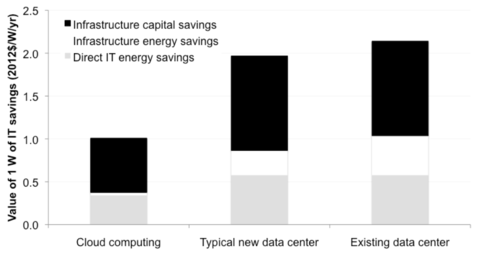
I summarize the results from these calculations in the following graph.  The key result is that avoided infrastructure savings represent more than half of the economic savings associated with reducing computing electricity use in the data center (under plausible assumptions for the relevant parameters in different types of data centers).  These economic benefits really matter, and analyses that don’t count them will mislead by substantially underestimating the benefits from efficiency improvements in computing equipment.

What’s one watt of electricity savings worth in the data center?

image

Notes:  Infrastructure capital savings apply to new construction or existing facilities that are power/cooling constrained.  Those savings total $8.6M/MW for cloud facilities and $15M/MW for others, from Uptime institute.  PUE = 1.1, 1.5, and 1.8 for Cloud, New, and Existing data centers, respectively.  Electricity price =$0.039/kWh for cloud facilities and $0.066/kWh for new/existing data centers. All costs in 2012 dollars.

Avoided infrastructure costs for cloud computing case reflect the lower bound of the 2nd quartile from Stanley and Schafer 2012.   For typical data centers, avoided infrastructure costs reflect the median value from Stanley and Schafer.  Avoided infrastructure costs only apply in existing facilities when they are power and/or cooling constrained.

Here are some more details on the Uptime estimates of infrastructure costs, summarized in the green DRAM report.

The cost of data center infrastructure is commonly summarized in millions of dollars per MW of IT load (which is equivalent to dollars per watt).  According to data compiled by 451 Research (Stanley and Schafer 2012), conventional data centers range in cost from about $5M to $29M/MW (2012 dollars), with 50% of the data centers falling between $8.6M and $18.8M/MW.  The median of their sample is at $15M/MW.
After conversations with the first author of the 451 Research report (John Stanley), I decided to use the bottom of the 2nd quartile ($8.6M/MW) as the avoided cost for Cloud Computing installations.   Stanley was concerned that data centers with costs at the lowest end of the range ($5M/MW) might not be comparable in reliability or other important characteristics with the high performance data centers that make up the vast majority of the 2nd and 3rd quartiles of the distribution.   I also decided to use the 451 Group’s median numbers ($15M/MW) as the value for Typical Existing and Recent Practice Facilities because “in-house” data center facilities are the ones most heavily represented in that report’s data sample.

So if you read or create analyses of the economic benefits of improving the efficiency of computing equipment, make sure they correctly account for the avoided infrastructure costs, which are substantial even in the most efficient data centers in the world.

References

Koomey, Jonathan G. 2012. The Economics of Green DRAM in Servers. Burlingame, CA: Analytics Press.  November 2. [http://www.mediafire.com/view/uj8j4ibos8cd9j3/Full_report_for_econ_of_green_RAM-v7.pdf]

Stanley, John, and Jason Schafer. 2012. The Economics of Prefabricated Modular Datacenters. San Francisco, CA: The 451 group/451 research.  May 11. [https://www.451research.com/report-long?icid=2266].

Our study of eBay's organizational transformation, just released

I and two former students of mine, Nicole Schuetz and Anna Kovaleva, just completed a wonderful case study of eBay’s transition to more efficient data center operations.  As readers of this blog know, the barriers to achieving higher efficiency data centers are not primarily technical.  Instead, they are mainly problems of management, incentives, and responsibilities.  This is why I’ve been pushing for years to create case studies of companies that have actually been successful in improving the efficiency of their operations.  I’ve encountered companies who have accomplished such improvements in the past, but none have ever wanted to talk about them, until now.

The Executive Summary of the case study is below.

eBay Inc.: A Case Study of Organizational Change Underlying Technical Infrastructure Optimization
Nicole Schuetz*, Anna Kovaleva*, and Jonathan Koomey**
*Stanford Graduate School of Business & Emmett Interdisciplinary Program in Environment and Resources, School of Earth Sciences, Stanford University
**Steyer-Taylor Center for Energy Policy and Finance, Stanford University
Executive Summary
This work provides a case study of the organizational changes necessary at eBay Inc. to support the development and operation of efficient data center infrastructure, hardware, and software. As a part of this process, the eBay Inc. infrastructure Engineering and Operations team (responsible for the delivery of technical services including Cloud services and data center hosting) embarked on a multi-year journey to dramatically improve the efficiency of the company’s technical infrastructure, and to connect infrastructure productivity to business drivers. eBay Inc.’s technical achievements in improving energy efficiency and decreasing infrastructure operations cost has been well documented elsewhere; instead this study focuses on illuminating the changes to eBay Inc.’s organizational structure and culture of the IT organization that began in 2008 and are still ongoing today. In addition to a literature review, the authors conducted in-person interviews with members of eBay Inc.’s staff within the IT organization between May and August of 2013.

Download the case study here.  To watch video of me and eBay’s Dean Nelson discussing some of the key issues emerging from the case study and the other innovations just announced for eBay’s Salt Lake City data center, go here (the interview is at 22 minutes into the video file).

Ken Brill: September 6, 1944–July 30, 2013

image

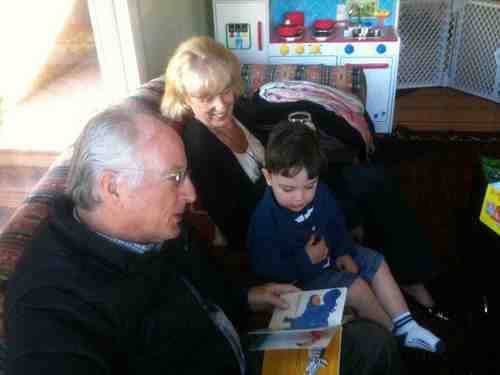
Ken and Margot Brill, with Ken reading to one of our sons, on May 8, 2011.  Photo credit:  Jonathan Koomey.

My dear friend Ken Brill passed away on July 30th, and a few of his colleagues and I gathered with Ken’s family in Maine on August 17th of this year to celebrate his life.  I’ve posted below links to the text of the eulogies given by me, Martin McCarthy of 451, and John T. Thornell of Upsite Technologies, and the homily by Rev. Timothy Boggs, so that people who weren’t able to attend the ceremony can read what we said, reflect on those thoughts, and add additional comments if they want.

What makes a great man?”, by Jonathan Koomey

Eulogy for Ken Brill”, by Martin McCarthy

In Honor of Ken Brill”, by John T. Thornell

Homily in Celebration and Thanksgiving for the Life of Ken Brill”, by Rev. Timothy A. Boggs

I’ve also posted the “Core Values“ document that Ken shared with all of his employees during the twelve years I’ve known him.  This document captures some of what made Ken special, and it’s worth a read.

Martin McCarthy ended his eulogy with a quote from Ken that sums it up  perfectly:  “‘Drop the boulder.  Grab the balloon.’ Let’s all grab a balloon for Ken.”

In talking with Jim Glanz, a reporter at the New York Times who wrote about data centers, I learned a few weeks ago that Ken had been especially proud of the video he and Jim did walking through a data center, with Ken explaining things as they walked.  It was created to accompany a long article Jim did that got lots of attention.  But Ken was much more interested in how many people had watched the video.  I post the link here, so more people can watch it!

Obituaries and Tributes for Ken Brill

There was an outpouring of discussion upon Ken’s passing, and I’ve collected some of the key links below. Please let me know if I’ve missed any important ones.

Portland Press Herald:  Obituary for Ken Brill

Uptime Institute:  Uptime Institute Grieves the Passing of Founder Ken Brill

Upsite Technologies Mourns the Passing of its Founder, Kenneth Brill, and Celebrates His Many Contributions to the Data Center Industry

The Register:  Ken Brill, ‘the father of data centers’, powers down at 69

PC World:  Data center innovator Ken Brill dies at 68

Computerworld:  Ken Brill, the man who defined the data center, dies

eWeek:  Ken Brill, Data Center Pioneer, dies at 69

The 7x24 Network’s tribute to Ken Brill

Data Center Dynamics:  Uptime Institute Founder Ken Brill Passes

Data Center Dynamics:  Info-graphic summarizing Ken Brill’s accomplishments

My eulogy for Ken Brill

What makes a great man?

Jonathan Koomey

St. Albans Episcopal Church Cape Elizabeth, Maine

August 17, 2013

We’re here to honor the life of a good friend and a great man: Ken Brill.  In preparing for this event, I contacted many of Ken’s friends and colleagues, all of whom spoke of him with gratitude, love, and admiration.

Ken’s was devoted to truth, which meant he was a real “data guy”.  That’s one of the things that drew us together. During the first Internet boom and the California electricity crisis (around 2001), some people with an ax to grind claimed data centers were using lots of electricity (hundreds of watts per square foot).  Ken called me one day out of the blue (he had helped one of my students, but we had never met) and said “I think I have some data that might be useful to you.”   Those data showed power use that was about one tenth of the conventional wisdom, and they changed the public conversation to better reflect reality.

Ken revered “getting it right”, even when inconvenient or  unprofitable.  John Stanley (now at Google), who I introduced to Ken and who worked with him for several years, told me about writing projects where the production people were driven crazy by last minute changes, but they were important substantive changes, not arbitrary or trivial ones.  He told John and me many times, “if you can’t afford to do it right the first time, how come you can afford to do it twice?”

Ken cared deeply about others doing well, and lived that caring by example. Andrew Fanara, formerly at the EPA, told me that he wouldn’t be where he is today professionally without the doors Ken opened for him.  And that feeling was echoed by every single person with whom I spoke.  Ken built an industry, in part by encouraging others to achieve their very best.  He multiplied his impact by influencing others, which is one mark of a truly great man.

Whenever I spoke with Ken, I felt like he was really listening to me, thinking about what I had said, and addressing my concerns.  He was genuinely interested in what others had to say, and was intensely curious about people with different views.  This curiosity is rare and special.  It’s something with which almost everyone is born, but most people lose it along the way.  Ken never did.

I also knew from the conversations we had that he loved his family very much, even though he knew he wasn’t the perfect father or husband (who among us is?).  So his caring extended to his entire life.

Ken didn’t dwell much on the past, he focused on creating the future.  Christian Belady, who many of you know, talked with Ken about two months ago.  In that conversation, Ken spent all his time talking about the future, even though he knew he only had a short time left on the planet.  Truly inspirational!

So what makes a great man?  Someone who stays true to himself, who faces reality as it is (not as he wishes it would be), who cares about others, who’s devoted to something larger than himself, and who keeps focused more on the future than on the past.

Ken Brill:  A good friend and a great man.

We’ll miss you, Ken, but we’ll carry forth your legacy by helping others to do their very best, with our eyes fixed firmly on the future.  I know that’s what you would have wanted.

Back to summary page of tributes to Ken Brill

Martin McCarthy's Eulogy for Ken Brill

Eulogy for Ken Brill

Martin McCarthy

St. Albans Episcopal Church Cape Elizabeth, Maine

August 17, 2013

I loved Ken Brill.

It took me 50 years of my life to get ready to meet this man, but I loved him. And in the last 5 years he’s been such an influence and such an inspiration to me, like few in my lifetime.

We shared Harvard Business School, though he was 10 years ahead of me.. as he was 10 years ahead in pretty much everything, for me and most others.

Howard Stephensen, one of the professors there at Harvard, defined entrepreneurship as “the pursuit of opportunity without regard to resources currently controlled”, and Ken was an entrepreneur.  Ken was an inventor, Ken was an inveterate tinkerer, Ken loved new ideas, he loved to debate.  And he thought it was a contact sport.

But Ken was more than just an entrepreneur, Ken was a founder.  Ken created, Ken was the originator, Ken came up with ideas, processes, means of associations and ways of understanding that few people can provide.

His reputation preceded him, and I remember being more than a little concerned about meeting Ken.  I had heard him speak and attended his conferences, I knew of him for years, but it took a little bit to get ready to meet Ken, because I needed to prove that I was worthy to take forward what he had devoted so much of his life to creating, in the form of his ideas and his Institute.  Thank god I was fortunate to at least get the chance to do so.

I think in ways, in the last 5 years, I’ve been doing what I’m doing today, trying to explain Ken to the world. To help others understand, how focused, how seminal, how impactful this man was in his chosen field.

I have the good fortune to live in upstate New York on the weekends, near the sacred grounds of Woodstock, which just commemorated its 44th anniversary a few days ago. Ken Brill was the “Woodstock of the Data Center industry”.  There were festivals that had been before and many that have come since, but Ken—like the Woodstock Music festival— was the moment, marked the moment….and this moment went on for years.

People would mark themselves in relationship to Ken.  “Were you there in the beginning?” “Were you with Ken when he founded Uptime?”  “How and how long did you know Ken?” In recent years I got to travel the world with Ken, in China, in Singapore, in Europe, in Oslo, in Paris, many places, and got to meet many people, and everywhere I went, people wanted to meet Ken Brill.  They wanted to know this man, one who had the vision to make something solid and worthwhile out of nothing.  Ken is rightfully known now as the “Father of the Data Center industry”. Who was this man, who in his own way, as much as Woodstock, really captured and embodied the zeitgeist of the time, and who really spawned a generation that followed…that’s what Ken did.

He’s an anarchist.  He’s a revolutionary.  He’s a counterculture figure of great impact and great reknown. He was a contrarian. He has lasted, and he will endure. His impact is profound.

Sometimes Ken would forget the broader context. He would dive in, but then get lost in the details, the technical specifics. He could go down and dive so deep, like those pearl divers, then come up for air, but he’d stay down for hours.  I would try to bring him back up and remind him that “You are (and I will edit this adjective for this church audience) “freaking” Ken Brill.  Remember that.  Ken, come back to the top.”

He was blunt and direct.

Compelling, but not so charming.

Devoted, and undeterred.

Deeply caring, but intellectually, totally unsentimental.

But his passion, his energy, his drive, his will, his appetite were inspiring.

He was brilliant, but bristly.

And I say again now what I said to him many times when we were working through the opportunity for me to move forward with him with the acquisition of his beloved Uptime Institute.

“Drop the Boulder…Seize the Balloon”

Seize the balloon.  Let’s all take a balloon for Ken.

Copyright 2013, By Martin McCarthy.  Reproduced here with permission.

Back to summary page of tributes to Ken Brill

John Thornell's eulogy for Ken Brill

In honor of Ken Brill

John Thornell

St. Albans Episcopal Church Cape Elizabeth, Maine

August 17, 2013

As the father of the data center industry, Ken has many accomplishments to his name. These accomplishments are the product of an insatiable curiosity, and an unrelenting passion, focus and drive. Sometimes this presented challenges for people, including myself. Ken and I achieved a lot together, but we also had our differences. In fact, in 2008, I left The Uptime Institute largely because of those differences.

A year ago March, Ken called. We hadn’t spoken in years. In fact, when I saw his number on my phone I almost instinctively sent it to voice mail! Instead, I answered. And I am glad that I did. It was a different Ken on the line. He was reflective and appreciative. He was even apologetic about those differences he and I had prior. But, more importantly, for the first time, Ken seemed content. With the Site Uptime Network launched in Asia, the Uptime Institute had become the global organization he envisioned.

Since that call in March, I’ve joined one of Ken’s companies, Upsite. Working with Ken again, I also noticed that he seemed to be in a mentoring phase of his career and life. In individual meetings he would coach not command. On board calls, he would give input not instructions. Ken seemed to have finally broken the entrepreneur’s curse! His diagnosis didn’t slow him down, either. He talked about offering a course at Redlands and other ways to share his experiences for the benefit of others. I am grateful to have had the opportunity to work with this new Ken.

So, it is in this mentoring spirit that I would like to share with you, Ken’s family and closest friends, excerpts of a set of core values that he assembled over the years. These values were drafted, as Ken said, to help people “make decisions and set priorities between conflicting objectives…” Some of the more common are:

A well-defined problem seeks its own solution
Think both/and, not either/or
Be hard on ideas, not people
Set people and projects up for success, don’t move the goal posts
Acknowledge and learn from problems, don’t hide from them
Recognize and celebrate success

Ken maintained nearly 40 of these core values. In my time working with him, I was surprised how frequently we used many of them. They would serve as short-cuts to remind us to “address structure, instead of content” which is yet another core value.

I am flattered that Ken asked me to join Upsite. To help fulfill the vision he has for the company. To contribute to his legacy. I regret not being able to work with him now, but will continue to use many of the experiences I’ve had with Ken, including his core values, in my life personally and professionally. I encourage each of you to do the same.

No doubt, Ken would be as pleased about helping others as he was about his own accomplishments.

Copyright 2013 by John T. Thornell.  Reproduced here with permission.

Back to summary page of tributes to Ken Brill

Homily by Reverend Boggs at Ken Brill's funeral

Homily in Celebration and Thanksgiving for the life of Ken Brill

The Rev. Timothy A. Boggs

St. Albans Episcopal Church Cape Elizabeth, Maine

August 17, 2013

Please pray with me for a moment.

Gracious God, please listen this hour to our words of joyful thanks and our sighs of grief. And in these contrasts, in the midst of our laughter and our loss, speak your clear words of life. Amen.

Good morning and thank you for being here. This is a rich day that we share, a rare time, full of so many precious and complex memories and emotions. You will each have your own personal understandings of this, your personal truths about rich times like these, but I hope you will agree that this is right where we should be today, together in this welcoming place, in this company, giving our time and our attention to this turning point, this intersection we all find ourselves in.

I honor all your understandings of this time, yet I want to suggest that from where I stand, there are three distinct things that we are doing together in this place at this hour.

We are here first of all to simply and fully offer our gratitude for the life and love of this generous man. To celebrate a life of such consequence, and to give thanks to God for Ken.

We have just heard this morning such wonderful witness of his gifts and his sharing of them. I only knew Ken through our occasional and too brief visits over these past months. I was smitten by him, his intelligence and curiosity and sparkle. And I’ll confess that I selfishly regret that I did not get to know him and love him as you did. So, I won’t presume to speak of that which you know so much better.

I am struck by the joy in Ken’s words and their echo in the family’s voices. Joy is different than mere happiness or satisfaction. Joy is a sense of the rightness of life. We do not make joy. We do not even discover it. It discovers us. It discovers us when we are open to the wonder and possibilities in all the gifts of God we have been given. I think Joy discovered Ken.

And then, in his own way, he shared it. He knew the truth that in giving we receive and each of you have been graciously gifted by him. We remain empowered by that love.

Of the many things we cannot avoid in life, one is that of becoming a teacher. For better or for worse, we are all teachers of those with whom we live and love and work and play. Ken was obviously such a fine teacher, a natural teacher, a teacher who opened doors for students, doors into.  And I know that however you knew him, you have each learned much from him, including a central lesson of his: that living life in a posture of gratitude.

So, we are here first to give thanks to God for the wonder and constancy of Ken’s generously-shared life, a life of such consequence and to shout right out loud our abidingly grateful love of him.

And we are also here to acknowledge our sufferings at this great loss, a loss which comes too soon. One of the reasons we are truly human is that we affirm that life is so very precious, and that death, expected though it is, confronts us with painful mysteries we cannot fully grasp.

We acknowledge the significance of this here in the midst of the traditions of our faith. The symbols, music, words of this service and the images, and light around us, the vaulting above us; these are all not so much meant to convey wisdom as wonder. Part of the reason we are here, in this place, embracing these traditions, is to acknowledge that life and love and death are part of a mystery we can know only in part.

We are seldom closer to the core of what makes us human than in moments like this, moments of great and acknowledged loss. So don’t be embarrassed by your tears or shy away from your sadness, they reflect your humanity…and Ken’s.

We are reminded this morning that it hurts to be in the valley of the shadow of death. The loss of people intertwined in our lives hurts us terribly when they are taken away. It leaves a hole, and holes in us hurt. That hurting reminds us that we are real, that we are human.

As Ken knew and taught so very well, there is only one antidote to loss and that is life. Grief is part of the story, but it’s not the end of the story. He knew that the holes of our lives, small and large, must be filled with something that is alive and life-giving, something like love.

So, we are here to give thanks, and we are here to mourn and we are also here in the crazy, radical hope of our faith that God will be in our lives and be with Ken still, that he may be ever closer to him. This hope at death is such a mystery to us. It is tied deeply into the entire gift and story of resurrection, that possibility of enduring, continuing relationship with God. Ken is not alone in finding this claim deeply mysterious and this is not the place for a discourse on the resurrection, except to say sitting with the uncertainty, as Ken and I were privileged to do, embracing the question is as any good engineer would know the first essential step.

What follows in our service are our songs and prayers and hymns and fellowship. They give us a chance to step back and experience the wholeness of all that we are doing today: our thanksgiving, our grief and our hope in enduring relationship.

And in that they allow us to hold up this dear man to the healing and illuminating light of God. I suspect God is not through with him just yet.

A priest friend recently wrote: “I’ve come think that if there is one single virtue: it’s integrity. By integrity, I don’t mean simply mean honest, I mean the word literally. It’s the quality of being an integer, an entity. He said, integrity is what happens when at your funeral your spouse talks to your pastor, who talks with your daughter, who talks with your neighbor, who talks with your colleague, who talks with your best friend, and they all discover that they knew the same person. You weren’t a series of masks worn for different relationships. You were complete.”

Ken was indeed that. An integer. An entity. Complete. No matter how much or little you knew of Ken or about Ken, what you always got was Ken.

May Ken now know the full reward of his life, may his relationships continue in your hearts and in his, may he somehow take joy still in God’s great creation.

And as a priest who came to him late in his life, may I say:

May he rest in peace. May he rise in glory. Amen

Copyright 2013 by the Rev. Timothy A. Boggs.  Reproduced here with permission.

Back to summary page of tributes to Ken Brill

Ken Brill's statement of principles, describing the core values he encouraged his employees to embrace

What follows is the statement of values Ken Brill shared with all his new employees in the twelve years that I knew him.  They reflect the kind of man he was:  someone who cared about people and who valued truth above all else, even when inconvenient or unprofitable.

Brill Family of Companies Core Values

Purpose of Core Values:  We make strategic and operational decisions and set priorities between conflicting objectives using our core values.  The following listing divides these everyday values into four major groupings:

1) First and foremost is our overarching, external focus on the customer.
2) The second category has to do with how we encourage everyone (employees, stakeholders, and consultants) to think about problems and tasks.
3) The third category is principles for how we relate with one another.
4) The final category relates to doing the right thing.

To read the full core values document, download the PDF here.

Copyright 2013 by Ken Brill.  Reproduced here with permission of Margot Brill.

Back to summary page of tributes to Ken Brill

Interesting tidbit on the airplane fuel needed to deliver iPhones from the factory in China

http://www.macrumors.com/2013/09/11/how-apple-ships-millions-of-iphones-for-simultaneous-delivery/

Why structured data is powerful and important

There’s been a lot of talk recently about how new computer tools can help us derive meaning from data that haven’t been pre-structured for ease of machine readability.

Of course, all data are structured in some way, but some forms of structure are easier for computers to handle than others.

Blog Archive
Jonathan Koomey

Koomey researches, writes, and lectures about climate solutions, critical thinking skills, and the environmental effects of information technology.

Partial Client List

  • AMD
  • Dupont
  • eBay
  • Global Business Network
  • Hewlett Packard
  • IBM
  • Intel
  • Microsoft
  • Procter & Gamble
  • Rocky Mountain Institute
  • Samsung
  • Sony
  • Sun Microsystems
  • The Uptime Institute