Homily by Reverend Boggs at Ken Brill's funeral

Homily in Celebration and Thanksgiving for the life of Ken Brill

The Rev. Timothy A. Boggs

St. Albans Episcopal Church Cape Elizabeth, Maine

August 17, 2013

Please pray with me for a moment.

Gracious God, please listen this hour to our words of joyful thanks and our sighs of grief. And in these contrasts, in the midst of our laughter and our loss, speak your clear words of life. Amen.

Good morning and thank you for being here. This is a rich day that we share, a rare time, full of so many precious and complex memories and emotions. You will each have your own personal understandings of this, your personal truths about rich times like these, but I hope you will agree that this is right where we should be today, together in this welcoming place, in this company, giving our time and our attention to this turning point, this intersection we all find ourselves in.

I honor all your understandings of this time, yet I want to suggest that from where I stand, there are three distinct things that we are doing together in this place at this hour.

We are here first of all to simply and fully offer our gratitude for the life and love of this generous man. To celebrate a life of such consequence, and to give thanks to God for Ken.

We have just heard this morning such wonderful witness of his gifts and his sharing of them. I only knew Ken through our occasional and too brief visits over these past months. I was smitten by him, his intelligence and curiosity and sparkle. And I’ll confess that I selfishly regret that I did not get to know him and love him as you did. So, I won’t presume to speak of that which you know so much better.

I am struck by the joy in Ken’s words and their echo in the family’s voices. Joy is different than mere happiness or satisfaction. Joy is a sense of the rightness of life. We do not make joy. We do not even discover it. It discovers us. It discovers us when we are open to the wonder and possibilities in all the gifts of God we have been given. I think Joy discovered Ken.

And then, in his own way, he shared it. He knew the truth that in giving we receive and each of you have been graciously gifted by him. We remain empowered by that love.

Of the many things we cannot avoid in life, one is that of becoming a teacher. For better or for worse, we are all teachers of those with whom we live and love and work and play. Ken was obviously such a fine teacher, a natural teacher, a teacher who opened doors for students, doors into.  And I know that however you knew him, you have each learned much from him, including a central lesson of his: that living life in a posture of gratitude.

So, we are here first to give thanks to God for the wonder and constancy of Ken’s generously-shared life, a life of such consequence and to shout right out loud our abidingly grateful love of him.

And we are also here to acknowledge our sufferings at this great loss, a loss which comes too soon. One of the reasons we are truly human is that we affirm that life is so very precious, and that death, expected though it is, confronts us with painful mysteries we cannot fully grasp.

We acknowledge the significance of this here in the midst of the traditions of our faith. The symbols, music, words of this service and the images, and light around us, the vaulting above us; these are all not so much meant to convey wisdom as wonder. Part of the reason we are here, in this place, embracing these traditions, is to acknowledge that life and love and death are part of a mystery we can know only in part.

We are seldom closer to the core of what makes us human than in moments like this, moments of great and acknowledged loss. So don’t be embarrassed by your tears or shy away from your sadness, they reflect your humanity…and Ken’s.

We are reminded this morning that it hurts to be in the valley of the shadow of death. The loss of people intertwined in our lives hurts us terribly when they are taken away. It leaves a hole, and holes in us hurt. That hurting reminds us that we are real, that we are human.

As Ken knew and taught so very well, there is only one antidote to loss and that is life. Grief is part of the story, but it’s not the end of the story. He knew that the holes of our lives, small and large, must be filled with something that is alive and life-giving, something like love.

So, we are here to give thanks, and we are here to mourn and we are also here in the crazy, radical hope of our faith that God will be in our lives and be with Ken still, that he may be ever closer to him. This hope at death is such a mystery to us. It is tied deeply into the entire gift and story of resurrection, that possibility of enduring, continuing relationship with God. Ken is not alone in finding this claim deeply mysterious and this is not the place for a discourse on the resurrection, except to say sitting with the uncertainty, as Ken and I were privileged to do, embracing the question is as any good engineer would know the first essential step.

What follows in our service are our songs and prayers and hymns and fellowship. They give us a chance to step back and experience the wholeness of all that we are doing today: our thanksgiving, our grief and our hope in enduring relationship.

And in that they allow us to hold up this dear man to the healing and illuminating light of God. I suspect God is not through with him just yet.

A priest friend recently wrote: “I’ve come think that if there is one single virtue: it’s integrity. By integrity, I don’t mean simply mean honest, I mean the word literally. It’s the quality of being an integer, an entity. He said, integrity is what happens when at your funeral your spouse talks to your pastor, who talks with your daughter, who talks with your neighbor, who talks with your colleague, who talks with your best friend, and they all discover that they knew the same person. You weren’t a series of masks worn for different relationships. You were complete.”

Ken was indeed that. An integer. An entity. Complete. No matter how much or little you knew of Ken or about Ken, what you always got was Ken.

May Ken now know the full reward of his life, may his relationships continue in your hearts and in his, may he somehow take joy still in God’s great creation.

And as a priest who came to him late in his life, may I say:

May he rest in peace. May he rise in glory. Amen

Copyright 2013 by the Rev. Timothy A. Boggs.  Reproduced here with permission.
Back to summary page of tributes to Ken Brill

Ken Brill's statement of principles, describing the core values he encouraged his employees to embrace

What follows is the statement of values Ken Brill shared with all his new employees in the twelve years that I knew him.  They reflect the kind of man he was:  someone who cared about people and who valued truth above all else, even when inconvenient or unprofitable.

Brill Family of Companies Core Values

Purpose of Core Values:  We make strategic and operational decisions and set priorities between conflicting objectives using our core values.  The following listing divides these everyday values into four major groupings:

1) First and foremost is our overarching, external focus on the customer.
2) The second category has to do with how we encourage everyone (employees, stakeholders, and consultants) to think about problems and tasks.
3) The third category is principles for how we relate with one another.
4) The final category relates to doing the right thing.

To read the full core values document, download the PDF here.

Copyright 2013 by Ken Brill.  Reproduced here with permission of Margot Brill.

Back to summary page of tributes to Ken Brill

Interesting tidbit on the airplane fuel needed to deliver iPhones from the factory in China

http://www.macrumors.com/2013/09/11/how-apple-ships-millions-of-iphones-for-simultaneous-delivery/

Why structured data is powerful and important

There’s been a lot of talk recently about how new computer tools can help us derive meaning from data that haven’t been pre-structured for ease of machine readability.

Of course, all data are structured in some way, but some forms of structure are easier for computers to handle than others.

Climate is no game, and it is never over

Dave Roberts had a wonderful post on August 30th, 2013 titled “Hope and Fellowship”, which addresses the question “Is there any hope? Or are we just f*cked?”  Here’s his brilliant summary:

And really, what else are we going to do?
Remember, there is no “too late” here, no “game over” — it will be a tragedy to shoot past 2 degrees to 3, but 4 is worse than 3, and 5 is worse than 4. Being unprepared for any of those will be much worse than being prepared. The future always forks; there are always better and worse paths ahead. There’s always a difference to be made.
When we ask for hope, then, I think we’re just asking for fellowship. The weight of climate change, like any weight, is easier to bear with others. And if there’s anything I’ve learned in these last 10 years, it’s that there are many, many others. They are out there, men and women of extraordinary imagination, courage, and perseverance, pouring themselves into this fight for a better future.
You are not alone. And as long as you are not alone, there is always hope.

Awhile back KC Golden had an hilarious post that makes a similar point (reposted on Climate Progress) titled

“Dad, Seriously, WTF Is Up With ‘Game Over’?!”

Dad, isn’t Jim Hansen that NASA mega-whiz you call “America’s pre-eminent climate scientist,” which is like geezerese for the smartest guy in the room?  And what is brain dude thinking when he says “Game over for the Climate”?

“Game”? You call this a game?  When losing it means“billions of people will be condemned to poverty and much of civilization will collapse”?  K. Ceee, I know you’re super-busy but I need you to pay attention.

Which part of this sounds like a game to you?  The billions?  The people?  The poverty?  The civilization?  The collapse?  Daaad, back away from the smartphone.  I mean it.  Focus!  You can’t just go “game over for the climate…  New game!”… like there’s an app for what happens after you lose this one.

Dad, dude, Angry Birds is a game.  Climate disruption is just dumping on your kids’ head.  Are you laughing?  Because if you’re laughing, I can find an assisted living facility in Siberia.  Don’t push me.

Read more…

The basic message is right on:  "It’s no game, and it is never over". It resonated strongly with me because of the evolutionary approach I lay out in Cold Cash, Cool Climate:

“I advocate instead an evolutionary approach to this problem, implementing many different technologies, failing fast, and doing more of what works and less of what doesn’t. This approach, which the National Research Council dubs “iterative risk management”, recognizes the limitations of economic models and puts such analysis into an important but less grandiose role:  that of comparing cost effectiveness of different mitigation options in achieving a normatively defined target (like the 2 degrees C warming limit).

I call this approach “working forward toward a goal” and it’s a more business-oriented framing of the problem.  It mirrors the way companies face big strategic challenges, because they know that forecasting the future accurately is impossible, so they set a goal and figure out what they’d have to do to meet it, then adjust course as developments dictate.   It also frees you from the mostly self-imposed conceptual constraints that make it hard to envision a future much different from what exists today.”

This is why I’m somewhat critical of Fatih Birol of the International Energy Agency declaring that “the door to a 2 degrees C trajectory is about to close”.  While I agree that there is real urgency to the climate problem, and it gets harder and harder to meet that limit with each passing year of inaction, we won’t be able to identify a moment in real time when it was possible before but it is now impossible.  Of course, we can say that if we continue on our current path for several more decades, we will indeed overshoot the 2 Celsius degree warming target, but there is significant uncertainty about exactly when we reach that point.  We won’t know until we’re well past the point of no return.

Each assessment of what is possible is flawed because of our imperfect foresight, and they all embody assumptions about what is possible and what isn’t.  The most common error is assuming that because we’ve built a capital stock we need to use it until it reaches the end of its life, but we probably won’t have that luxury.  The analysis of stock turnover I did in Chapter 5 of Cold Cash, Cool Climate convinced me that we’re going to have to scrap some capital even if we start aggressively reducing emissions tomorrow, but of course the more we build now the more we’ll have to scrap later.

That in itself should clarify things for those now fighting to build more emissions intensive infrastructure–there’s a real business risk to them because once the world finally accepts that rapid reductions of emission are required, those investors will lose their money.  This change of situation will occur in the next decade or so (it really must if we’re to turn this around–reality is a harsh mistress).  Some investors have already gotten that message and are starting to divest from fossil fuels. Once markets turn, they move very rapidly, and this situation will be no exception.

I also like Golden’s and Robert’s framing because there are always people eager to throw up their hands and say “we’re doomed!”.  That’s not helpful, of course–better that we give it our best shot even if we think it’s going to be very difficult to succeed. Humans are notoriously bad at predicting the future, for some very good reasons, so better not to be paralyzed by forecasts that are very likely to be wrong in any case.

So have hope, and be optimistic.  There’s every reason to believe that we can make more rapid changes than conventional wisdom would indicate. The future is ours to create.  With every choice we make, let’s ensure the future we create is a hopeful one.

Just because we've always done it that way doesn't mean we always need to

I just encountered another example of how re-imagining the way we deliver services can enable very low-cost access to communications.  My friend RJ Honicky wrote a paper in 2007 with colleagues at UC Berkeley describing how a “voice message mostly” mobile phone system could lead to improved equipment utilization, better service coverage, better quality of service, and much lower costs in developing countries.

The paper came out six years ago, so some technical details have no doubt changed, but the basic lesson is still a powerful one.  Just because we deployed mobile communications in a certain way in developed countries doesn’t mean we need to do the same thing in other places, and changing the business model for these services can result in substantial cost reductions and energy savings.

Honicky, R. J., Omar Bakr, Michael Demmer, and Eric Brewer. 2007. A message oriented phone system for low cost connectivity.  [http://citeseerx.ist.psu.edu/viewdoc/download?doi=10.1.1.91.1694&rep=rep1&type=pdf]

How a brilliant entrepreneurial innovator thinks about climate solutions

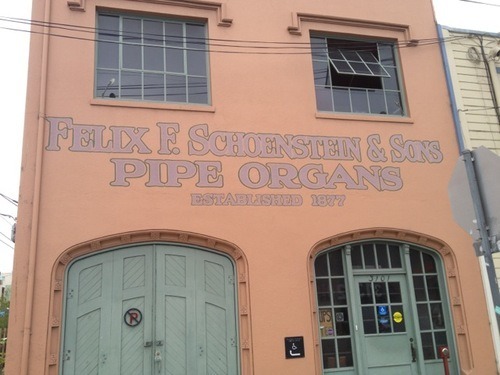
I visited my friend Saul Griffith at Other Lab on August 9th, 2013.  The lab is housed in the old Schoenstein & Sons pipe organ factory in San Francisco.  It’s a beautiful building, with its offices and hallways straight out of a Dashiell Hammett novel.

image

I loved visiting the lab because it was so inspirational.  I encountered inflatable robots, pneumatic solar mirror controls, a new kind of high pressure tank for storing natural gas or hydrogen for vehicles, 3D milling machines, high powered laser cutters, and custom-designed bicycles sized to fit your measurements.  Cool stuff, and it reminded me that we need not be hamstrung by how things have been done in the past.  The future is indeed ours to create!

Saul was good enough to write the forward to Cold Cash, Cool Climate:  Science-based Advice for Ecological Entrepreneurs in 2011, and he’s given permission for me to repost it below.  This will give you a flavor for how a brilliant entrepreneurial innovator thinks about climate solutions at a high level.

If equations aren’t your thing, just skip them and read the summaries just below each one.  You’ll get the gist.

Saul Griffith’s Foreword to Cold Cash, Cool Climate

Climate change, energy independence, and sustainability: all of these things are rightly getting more attention than ever before. They are complex global problems requiring not one, but thousands, of solutions. Some solutions require mandates, some rely on politics, some need technology, and some hinge on behavioral change. All of the solutions will require entrepreneurs – stubborn, fast-moving, single-minded, goal-oriented individuals, either in the private or public sector. Without these entrepreneurs pushing boundaries and the speed of deployment, uptake of these solutions will be too slow to avert the worst consequences of these global challenges. This book is a motivational treatise that pushes the green entrepreneur of the future to fulfill this important role.

More than that, this book is about the scientific knowledge that helps define the character and limitations of these solutions. If we are to leave a livable world (and hopefully a vital and vibrant world) for our children and grandchildren, the scale of what needs to happen this century is daunting.  Achieving even a mildly ambitious outcome of stabilizing the climate at 450 parts per million (ppm) of CO2 equivalent will mean the world of our future will look very different from today. Our transportation systems, heating and cooling systems, built environment and architecture, food systems, and even healthcare and education systems will all need to change – some a little, most a lot. Lots of people are scared of change, but the true entrepreneur embraces it. This is the green entrepreneur’s century.

Back in 2007 I was bedridden with chicken pox. Like most entrepreneurs I don’t take to idleness very well, so I set myself a task: measure every measurable impact of my lifestyle in terms of energy. I was already a ‘Green Entrepreneur’ – the CEO of a venture-financed, utility-scale wind energy start-up – and generally someone that people would look at as a model citizen when it comes to the environment and combating climate change. I was (mostly) a bicycle commuter; I was working on audacious new energy technologies.

What I learned shocked me. Although I thought I was a model citizen of the new cleaner world, I found that my lifestyle was consuming double or more the amount of energy that the average American was, and more than ten times that of the average Chinese citizen! Measuring everything that I did, quite literally down to my use of aluminum foil for cooking, and of the choice of textiles that I wore (as well as the more obvious things like miles travelled and electricity consumption), I realized that we now live in an age of consequence. It is possible to measure everything that you do – and its environmental impact. Whether you care about water, energy, carbon, or habitat destruction, we can now infer or estimate the impact of any purchasing decision on any of those outcomes. This exercise also made me furious with the often misleading reporting on new ‘green’ products and technologies. I became an angry young man again.

Being angry doesn’t help much though, whereas being an entrepreneur does. It’s been a few years since I had my wake-up call. People typically believe that the future for their children will be better, brighter, cleaner, and more wonderful than the past. That’s our challenge right now. We have to figure out how to make the future better than the past, while meeting the implied demands of the science of climate change. I no longer get angry about poorly written press releases and green-washing. In fact, they’re probably useful in that they socialize the idea of a cleaner and greener future, while the entrepreneurs who do the math, and have the analytical rigor, create the truly revolutionary products consumers are increasingly starting to demand.

I’m personally dedicated to creating these new products and services and bringing them to market. I have to acknowledge, however, that we need lots of entrepreneurs, working on lots of things, so that all of our contributions will add up to the kind of future that we want to live in – one that will be more wonderful than the past. It means that we’ll need to develop new sources of energy, and that there are thousands of technologies, solutions, and great companies to be built in the trillion-dollar energy generation game. There are even more technologies, solutions and great companies to be built in the consumer space. Here’s the trick: think of any product or service that you use today, whether it be how you get your milk, how you heat your home, or how you get your music. Figure out a way to deliver that product or service at one-half, or even better, one-tenth the amount of energy/water/habitat destruction/toxicity, and you likely have yourself a multi-million or multi-billion dollar product or service.  This is why this book will be a great guide for the entrepreneurs of this century, and why Koomey’s treatment of the subject matter provides a great handle for the time-strapped entrepreneur.

There is a huge amount of science and engineering and math that the entrepreneur of the future would like to know, but in some sense we can reduce the problem to a few handy pieces of technically grounded practical advice.  In the sections that follow, I include the equations for the technically minded reader, but you can just jump straight to the summaries that immediately follow those if you prefer.

Regarding travel of any kind

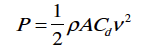
In high school, we learn mechanics in the Newtonian world, but in reality, almost any time we move, we do so through a fluid, usually air or water. Thus, for almost any transportation the power P required to move an object is given (roughly) by

image

where ρ is the density of the fluid (usually air or water), A is the frontal area of the moving body, Cd is drag coefficient, which is determined by the shape, and v is the velocity of movement. Colloquially speaking, this means to design any product or service that has to move with a lower power or energy requirement:

• Decrease A. Make it small and long.

• Decrease Cd. Make it aerodynamic, or ‘fish-shaped’.

• Decrease v2. Travel slowly.

This means that a really big, fast, low-energy super car is never going to exist, despite the attractiveness of the idea. Beautiful designed cars that recognize the constraints of the physics above could be far more efficient, and more of a pleasure to drive (or be robotically driven in). For short trips we will do even better by not driving at all, and by utilizing modern electric drive trains in lightweight personal vehicles.

Regarding the heating or cooling of anything

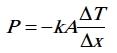
The power P required to heat or cool any object is given by

image

where k is the object’s thermal conductivity, A is the cross-sectional area between hot and cold, ∆T is the temperature difference, and ∆x is the distance between hot and cold. As above, this equation implies that to make more efficient transfers of heat, we must

• Decrease k. Insulate well.

• Increase ∆x. Use thick walls.

• Decrease A. Small is beautiful.

• Decrease ∆T. Heat or cool only as much as necessary.

Regarding the manufacturing of anything

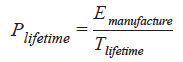
The average power requirement over the life of a product is given by

image

And Eembodied is the energy content of the material of which a device is constructed.

image

What these equations say is that we must:

• Decrease Mmassofobject. Make it weigh less.

• Decrease Eembodied. Use materials with lower embodied energy (e.g. substitute wood for aluminum).

•Increase Tlifetime. Making objects that last much longer, perhaps with service and repair-based business models, will have the biggest effect.

Regarding the design of electronics

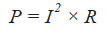
The average power requirement over the life of a product is given by

image

where I = current and R = resistance.

This equation implies that lowering resistance and current will reduce the power needed to accomplish a task. For electrical devices:

• reduce the current (I) by improving efficiency and redesigning the task

• make the wires bigger (reduces R)

Harness the power of information

Of course, the most important new tool we have in our toolbox is information. Wherever possible, use information technology to eliminate wasteful energy use. Examples abound: Replacing flights or driving by teleconferencing is a huge win for the environment. Using information to match needs with wants, such as ZipCar or City Car Share, eliminates the need for ownership of energy-intensive items. Using information technology such as Netflix, the Kindle, or the Apple iPad eliminates the physical delivery of goods.

A call for prompt action

The battle is not over once we have pioneered newer, more ecological technologies. We must still overcome the political, cultural and economic barriers to get people to adopt the low carbon options really fast. With these challenges, the imperative of this book is more apt than ever: we need entrepreneurs to lead the decarbonization of our lives now, and to make it happen pronto! I hope this book serves as a call to action for the next generation to capitalize on this age of consequence, building an awesome future harmonious with our understanding of how our home planet works.

-Saul Griffith, Ph.D., Other Lab, San Francisco, CA, October 12, 2011

Kudos to Amazon.com for making Kindle recycling simple

My old Kindle 2 gave up the ghost awhile back, and I finally got around to doing something about it.  I ended up getting a refurbished PaperWhite, which works fine, and has much longer battery life than the Kindle 2 (thanks to progress in battery, screen, communications, and computing technologies, which we discuss in detail in a forthcoming article in the Annual Review of Environmental and Resources).

The part of the process that I didn’t expect to be so easy was recycling the old kindle.  Instead of having to hunt around for local recyclers, I just searched for Kindle recycling online and found this site through Amazon.com:  http://recycling.ecotakeback.com.  I entered my name, address, and email, and it printed a prepaid UPS label.  That was it, so off to UPS it goes.  That counts as responsible environmental stewardship by any measure!

I’m sure other companies have programs like this, so I’m interested to hear your experiences, both good and bad.  Email me!

Addendum:  Readers of Cold Cash, Cool Climate:  Science-based Advice for Ecological Entrepreneurs will remember that extended producer responsibility, which requires manufacturers to take responsibility for their products at the end of life, is one way to modify property rights to ensure better choices from the environmental perspective.  Almost all analyses of options for reducing greenhouse gas emissions ignore the potential for changing property rights, but it’s a powerful way to create new possibilities for better environmental performance.

The electricity used by iPhones and refrigerators, take two

Joe Romm at Climate Progress was good enough to post my analysis of the recent claim that your iPhone uses as much electricity as two refrigerators.  This issue was highlighted in Friday’s edition of NPR’s Marketplace program, which thankfully didn’t fall into the false balance trap that many journalists find irresistible.  Here’s the short summary and introduction, which will give you the overall picture:

Short summary

Mark Mills created headlines in the past week by claiming that all the power needed to bring data to the iPhone, plus all the related energy to manufacture it and the related network equipment, makes it responsible for as much electricity as two refrigerators.  A more careful analysis confirms that Mr. Mills has overestimated the electricity associated with an iPhone by at least a factor of 18. Unfortunately, some parts of the media seem unable to ignore this verifiably false but otherwise quite memorable headline.

Introduction

Last week several of my friends alerted me to a claim that the iPhone uses as much electricity as two refrigerators when you count the energy needed to make it, run it and power the “behind-the-wall” equipment to deliver data to the device.  Discussion of the original report (“The Cloud Begins with Coal”, hereafter CBC) showed up on the Breakthrough Institute site, Time Magazine Online, MSN News, the Huffington Post, MarketWatch, and Grist, among others (with most focusing on the comparison between a smart phone and one refrigerator.

When I heard this claim, it took me back to the year 2000, when Mark P. Mills and Peter Huber first made the claim that the networking electricity for a wireless Palm VII exceeded the electricity for running a refrigerator (1000 to 2000 kWh, they claimed, the lower bound of which was a bit higher than the average installed base for US fridges at that time).  It didn’t sound plausible, and so I and some colleagues investigated, finding that Mr. Mills and Mr. Huber had overestimated the electricity needed to feed data to a wireless Palm VII by a factor of 2000 (Koomey et al. 2004).

Just as happened last time, Mr. Mills, in the CBC report, has made attention-getting claims that don’t stand up to scrutiny (Kawamoto et al. 2002, Koomey 2000, Koomey 2003, Koomey 2008, Koomey et al. 1999, Koomey et al. 2002, Koomey et al. 2004, Romm et al. 1999, Roth et al. 2002).  He cherry picks numbers to achieve his desired results, and his report has vague or non-existent references (but lots of footnotes).  This appears to be an attempt to create a patina of respectibility for his calculations while obfuscating his methods, but I don’t know for sure.

The big story here is why the media is paying any attention to this report at all.  Mr. Mills proved more than a decade ago that he is not a reliable source on the issue of electricity used by information technology.  His recent work simply confirms this conclusion.  Unfortunately, it also confirms what seems to be an inability of most media outlets to report sensibly about technical topics, in part because of the pressure to generate attention-getting headlines, regardless of their veracity.  This sorry episode does not make me optimistic for our ability as a society to deal with complex issues like climate change in the 21st century unless we change the way media reporting is conducted on technical issues.

Read more…

Story on NPR's Marketplace about the fridge vs. iPhone comparison

Adriene Hill of NPR’s marketplace program did a nice job describing the fridge vs. iPhone story today (“No, your phone doesn’t use as much electricity as a refrigerator”).  My favorite part of the story was my friend Bruce Nordman’s analogy about the three headed cat:

“If I came up to you and remarked to you that there is a one-headed cat around the corner from your house you would be totally uninterested,” says Bruce Nordman, a research scientist at Lawrence Berkeley National Laboratory*, “but if I said there was a three-headed cat you’d be amazed that it exists and want to go see it; so these fantastical assertions naturally attract people’s attention, whether or not they are real.”

Now that’s a great analogy.  I wish I had thought of that!

For more background and history about the last time people made claims like these, see this recent post.

Wild claims about electricity used by computers that just won't die (but should)

Mark P. Mills has reappeared, and remarkably is repeating some of the same wild claims that we debunked last time (circa 1999-2003).  As a public service, I’ve listed the most important documents summarizing the previous controversy for the benefit of media folks and other interested parties who otherwise would have a hard time piecing it all together.  Bottom line:  Mr. Mills has made so many incorrect claims that he simply shouldn’t be treated as a serious participant in discussions about electricity used by information technology (IT) equipment.  He cherry picks numbers to suit his narrative, and creates the appearance of doing real research by including many footnotes, but almost invariably he overestimates the amount of electricity used by IT equipment.  Last time many important people were misled by his antics–I hope they are smarter this time.

1) Read the Epilogue to the 2nd edition of my book Turning Numbers into Knowledge, which is a good overall summary of the controversy and its resolution.

Koomey, Jonathan. 2008. Turning Numbers into Knowledge:  Mastering the Art of Problem Solving. 2nd ed. Oakland, CA: Analytics Press.

2) Here’s the initial article in Forbes in 1999:

Huber, Peter, and Mark P. Mills. 1999. “Dig more coal—the PCs are coming.” In Forbes. May 31. pp. 70-72. [http://www.forbes.com/global/1999/0531/0211100a.html]

3) The Forbes article got the most attention, but it was supported by another report.  Email me directly for a copy of this one.

Mills, Mark P. 1999. The Internet Begins with Coal:  A Preliminary Exploration of the Impact of the Internet on Electricity Consumption. Arlington, VA: The Greening Earth Society.  May.

4) Amory Lovins posted an exchange of emails between him and Mills in 1999 (with a few others of us as occasional participants or observers).  It’s downloadable here:

Exchanges between Mark Mills and Amory Lovins - Rocky Mountain …

5) My colleagues and I at LBNL did an initial analysis memo soon after the Forbes article came out:

Koomey, Jonathan, Kaoru Kawamoto, Bruce Nordman, Mary Ann Piette, and Richard E. Brown. 1999. Initial comments on ‘The Internet Begins with Coal’. Berkeley, CA: Lawrence Berkeley National Laboratory. LBNL-44698.  December 9. [http://enduse.lbl.gov/SharedData/IT/Forbescritique991209.pdf]

6) Mills did congressional testimony on Feb 2, 2000, and I did an annotated rebuttal.

Koomey, Jonathan G. 2000. Rebuttal to Testimony on ‘Kyoto and the Internet: The Energy Implications of the Digital Economy’. Berkeley, CA: Lawrence Berkeley National Laboratory. LBNL-46509.  August. [http://enduse.lbl.gov/Info/annotatedmillstestimony.pdf]

7) Huber and Mills published a widely read op-ed in the WSJ in 2000, which is where they talked about the network electricity for a Palm pilot using as much electricity as a fridge.

Huber, Peter, and Mark P. Mills. 2000. “Got a Computer?  More Power to You.” Wall Street Journal.  New York, NY.  September 7. p. A26. [http://www.manhattan-institute.org/html/miarticle.htm?id=4524]

8) My former group at LBNL did a careful bottom up analysis of US IT electricity use, finding much lower numbers than did Mills, and publishing in the peer reviewed Energy-the International Journal in 2002 (Email me for a copy of this one):

Kawamoto, Kaoru, Jonathan Koomey, Bruce Nordman, Richard E. Brown, Maryann Piette, Michael Ting, and Alan Meier. 2002. “Electricity Used by Office Equipment and Network Equipment in the U.S."  Energy–The International Journal (also LBNL-45917).  vol. 27, no. 3. March. pp. 255-269.

9) Kurt Roth at ADL did a study that validated the work in item #7.

Roth, Kurt, Fred Goldstein, and Jonathan Kleinman. 2002. Energy Consumption by Office and Telecommunications Equipment in Commercial Buildings–Volume I:  Energy Consumption Baseline. Washington, DC: Prepared by Arthur D. Little for the U.S. Department of Energy. A.D. Little Reference no. 72895-00.  January. [http://www.mediafire.com/?75ykfz6rdmex11s]

10) I and other colleagues published an article titled "Sorry, wrong number” in which we described the Mills’ estimates as one of several examples of widely cited energy statistics that were wildly wrong (Email me for a copy of this one).

Koomey, Jonathan, Chris Calwell, Skip Laitner, Jane Thornton, Richard E. Brown, Joe Eto, Carrie Webber, and Cathy Cullicott. 2002. “Sorry, wrong number:  The use and misuse of numerical facts in analysis and media reporting of energy issues."  In Annual Review of Energy and the Environment 2002. Edited by R. H. Socolow, D. Anderson and J. Harte. Palo Alto, CA: Annual Reviews, Inc. (also LBNL-50499). pp. 119-158.

11) I wrote a 2 page summary article, also titled "Sorry, wrong number” but with a different subtitle, describing why getting the numbers right on this topic really matters, and giving advice to help people avoid getting fooled by charlatans (Email me for a copy of this one).

Koomey, Jonathan. 2003. “Sorry, Wrong Number:  Separating Fact from Fiction in the Information Age.” In IEEE Spectrum. June. pp. 11-12.

12) In the last of our detailed debunkings, we dissected the “network electricity use of a wireless PDA is more than that of a refrigerator” myth perpetuated by Mr. Mills, with a little help from my friends at Palm (Email me for a copy of this one).

Koomey, Jonathan, Huimin Chong, Woonsien Loh, Bruce Nordman, and Michele Blazek. 2004. “Network electricity use associated with wireless personal digital assistants."  The ASCE Journal of Infrastructure Systems (also LBNL-54105).  vol. 10, no. 3. September. pp. 131-137.

13) There’s an LBNL site that contains a lot of relevant material, but it hasn’t been updated since I left LBNL in 2003:  http://enduse.lbl.gov/Projects/InfoTech.html

Addendum:

14) Joe Romm just reminded me of the article he did for a Rand conference that ultimately ended up in a refereed journal (Resources, Conservation, and Recycling), in which he analyzed Mills’ claims from a macro perspective, and showed that the only way those could be true would be if electricity intensity of the economy was increasing after the advent of the Internet, but of course the exact opposite was true.  This argument was summarized in Item 10, above.

Romm, Joe. 2002. "The Internet and the new energy economy."  Resources, Conservation, and Recycling.  vol. 36, no. 3. October. pp. 197-210. [http://www.sciencedirect.com/science/article/pii/S0921344902000848]

To download the conference paper version from Rand for free, go to http://192.5.14.43/content/dam/rand/pubs/conf_proceedings/CF170z1-1/CF170.1.romm.pdf

15) Also important is this article by Romm et al. that discusses the broader systemic effects that the Internet enables.

Romm, Joe, Arthur Rosenfeld, and Susan Herrmann. 1999. The Internet Economy and Global Warming. Washington, DC: Center for Energy & Climate Solutions.   [http://infohouse.p2ric.org/ref/04/03784/0378401.pdf]

An open letter to Google about their fundraiser for Senator James Inhofe

Some colleagues and I, all of whom were Google Science Communication Fellows in 2011, wrote and posted at Climate Science Watch an open letter to Eric Schmidt and Larry Page of Google about their fundraiser for Senator James Inhofe.  You can read the letter here.

Four of us also wrote a more extensive essay, which Andy Revkin posted at his Dot Earth blog.  We’re hopeful that our efforts will stimulate discussion of how corporate america should deal with those (like Senator Inhofe) who deny the reality of climate change.

Comments welcomed!

Here’s the link to the open letter:

http://www.climatesciencewatch.org/2013/08/01/open-letter-from-google-science-communication-fellows/

Here’s the link to the longer essay:

http://dotearth.blogs.nytimes.com/2013/08/01/google-science-fellows-challenge-companys-support-for-inhof/?_r=1&

Addendum, August 1, 2013 8:15pm:  There’s an article describing the open letter on Climate Progress that has more than 3100 Facebook “likes”, which is more than any other article with which I’ve ever been associated.

The headline is slightly misleading, as we’re not “Google’s own scientists”, but it’s still worth a read.

My Technology Review  article called “The Computing Trend that Will Change Everything” received 1100 Facebook likes and the editors thought it was a blockbuster.  Getting a tweet from Vinod Khosla (and lots of others) helped in that instance.  Given that it’s got more than three times as many “likes”, I think it’s fair to say that the open letter to Google has gone viral.

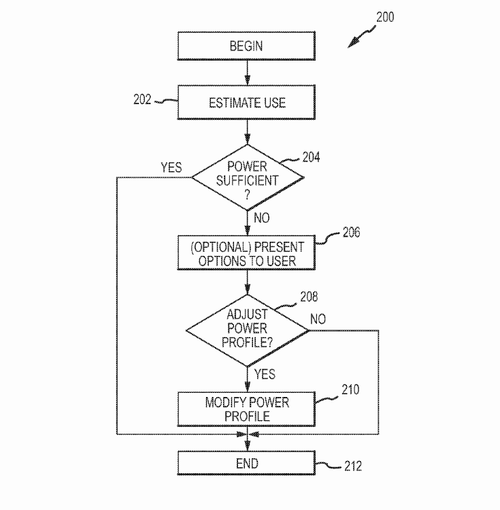
Apple patent points to the future of power management for mobile computing devices

This Apple patent points to the future of power management for mobile computing devices.  Devices will use context-specific information (like estimating how far you are from your destination using the GPS in your phone) to help decide when to reduce power use and extend battery life.  Smart everything, getting smarter all the time!

Mac Rumors:  Apple Applies for Patent on Intelligent ‘Power Management for Electronic Devices’
A newly published patent application from Apple describes a “power management for electronic devices” system, which detects the usage…
image

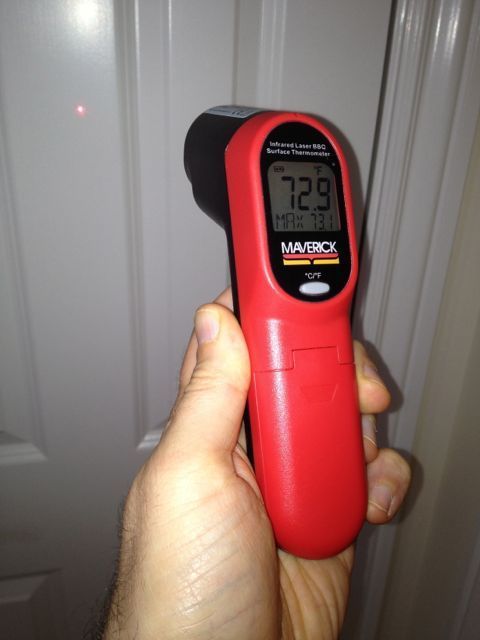
An outstanding gadget for anyone who wants to learn about temperature and heat flow

Because of the recent heat wave around here, I’ve been trying to figure out how to keep our house from heating up so much.  I started using a Maverick Laser Surface Thermometer to learn more about heat flows and temperatures inside the house.  It retails for about $35 on Amazon, and is incredibly useful, in part because it gives you a nearly instantaneous temperature measurement of surfaces up to 5 feet away.  The claim is that it can measure temperatures from -58 degrees F to 1022 degrees F, and is useful for cooking as well as home energy work.

image

For example, my contractor suggested putting up some reflective foil insulation on the inside of the attic ceiling.  To test this idea, I thumbtacked a sample of the insulation onto the inside of the roof in the attic and put the laser thermometer to work.  Sure enough, the reflective insulation reduced the surface temperature by 5-6 degrees F compared to the plywood next to it.

I also randomly started aiming the laser at different parts of the wall, and found that our downstairs thermostat is on the opposite side of the wall from our garage water heater, and so registers about 2 degrees F higher than the interior wall and the associated air temperature.  Good to know!

Of course, lasers aren’t for kids, so be sure to keep this tool in a safe place, but if you are at all interested in where your heat is going, this device can help.

Our article in Nature Climate Change just came out: Characteristics of Low Carbon Data Centres

This article gives a tidy summary of the key factors affecting the greenhouse gas emissions associated with data centers, and helps readers prioritize how best to reduce those emissions.  The three areas for improvement are the efficiency of the information technology (IT) equipment (servers, storage, and communications), the efficiency of the infrastructure equipment (fans, cooling, pumps, power distribution), and the carbon intensity of electricity production.

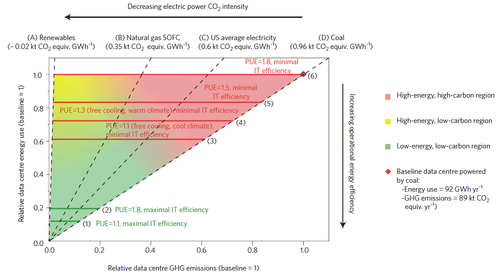
These factors can be conveniently pictured using what we call a “data center energy-carbon performance map” like the one shown in Figure 1:

image

Figure 1:  The data center energy-carbon performance map.  The shaded area bounds the potential operational energy and carbon performance range of a prototype US data centre and illustrates the relative performance of different data centre characteristics. Coloured areas indicate general regions of energy–carbon performance. For some data centres, only subareas of this map will apply depending on equipment and electrical power constraints. Numbered points are discussed in the text of the article. See section S2 of the Supplementary Information for details. GHG=greenhouse gas, PUE= Power Utilization Effectiveness.  Download a larger version.

The prototypical data center powered by coal-fired electricity is in the upper right hand corner, while the best place for a data center to be is in the lower left hand corner (high IT efficiency, low energy, low emissions).  Note that you can have a high energy, high emissions facility with very low Power Utilization Effectiveness (PUE, the industry standard metric for infrastructure losses.  A PUE of 1.0 represents zero infrastructure energy losses, with typical existing “in-house” facilities having PUEs of 1.8 or 1.9.  In those facilities, there is 0.8-0.9 kWh of infrastructure overhead for every kWh of IT load).

The critical lesson from the analysis is that IT efficiency (which includes higher utilization and performance improvements as well as purchasing efficient hardware) is the most important issue on which to focus.  Most recent efforts in the industry have been on improving infrastructure efficiency, which has many beneficial effects, but is not as important a lever as is the IT efficiency (in many new facilities we are reaching the limits of infrastructure efficiency, with PUEs as low as 1.04).  The article also makes clear that just switching an inefficient data center to low carbon electricity isn’t a good choice, because it uses up scarce low carbon electricity that could otherwise be used elsewhere.

Here’s the key paragraph from the conclusions:

Here we offer the following recommendations to policymakers who seek to design effective incentives for low-carbon data centres: all existing data centres should maximize IT-device efficiency, especially as these devices can turn over quickly and thereby deliver rapid improvements. Decisions regarding when to upgrade remaining devices to more efficient models can be informed in part by a break-even analysis of the embodied emissions required to manufacture new devices versus the operational energy savings that would be realized. New data centres should locate in areas with ample free cooling and/or low-carbon electricity grids to further push operations towards better energy and carbon performance. In new or existing facilities where optimal IT-device efficiency is not feasible, significant reductions in PUE critically rise in importance as a policy aim (but still result in higher energy-use levels than efficient IT devices would deliver). Where such PUE reductions are constrained by location (for example, a lack of free cooling), procuring low-carbon electricity — either from local electricity providers or through the installation of reduced-carbon self-generation such as Solid Oxide Fuel Cells — becomes the next chief lever after energy efficiency has reached its practical limit. With these insights in mind, public- and private-sector policymakers can accelerate the transition to a low-carbon Internet by aligning their incentives with data centre characteristics that matter.

The article summarizes some important lessons for those thinking about low emission data centers, and I highly recommend reading it if you are interested in this area.  It’s a short, crisply written paper, and one that should yield real insight if you’re thinking deeply about these issues.  Please email me if you’d like a copy (it’s behind a paywall).

Masanet, Eric, Arman Shehabi, and Jonathan Koomey. 2013. “Characteristics of Low-Carbon Data Centers."  Nature Climate Change.  vol. 3, no. 7. July. pp. 627-630. [http://dx.doi.org/10.1038/nclimate1786 and http://www.nature.com/nclimate/journal/v3/n7/abs/nclimate1786.html#supplementary-information]

Addendum:  Katie Fehrenbacher of GigaOm just wrote a short summary of the article.

Blog Archive
Jonathan Koomey

Koomey researches, writes, and lectures about climate solutions, critical thinking skills, and the environmental effects of information technology.

Partial Client List

  • AMD
  • Dupont
  • eBay
  • Global Business Network
  • Hewlett Packard
  • IBM
  • Intel
  • Microsoft
  • Procter & Gamble
  • Rocky Mountain Institute
  • Samsung
  • Sony
  • Sun Microsystems
  • The Uptime Institute