What's next for computing?
On Friday October 16th, 2026, I gave a keynote talk at the annual conference of the company PDF, which is a key data and analysis provider for the semiconductor industry.
The talk focused on opportunities for improving efficiency and performance of computing as Moore's law continues to slow. Improvements are possible at the top of the computing stack (Leiserson et al. 2020) as well as in further shrinking logic switches (Feynman 1992, 1993, 2001), but capturing those opportunities will require changes in technology, organization, and business models. Download the talk here. Video to follow.
This talk is the first public viewing of some results of our new processor database, on which Koomey Analytics been working with colleagues at MIT for the past couple of years. The processor database for CPUs and GPUs will be released officially in November at Supercomputer 2026.
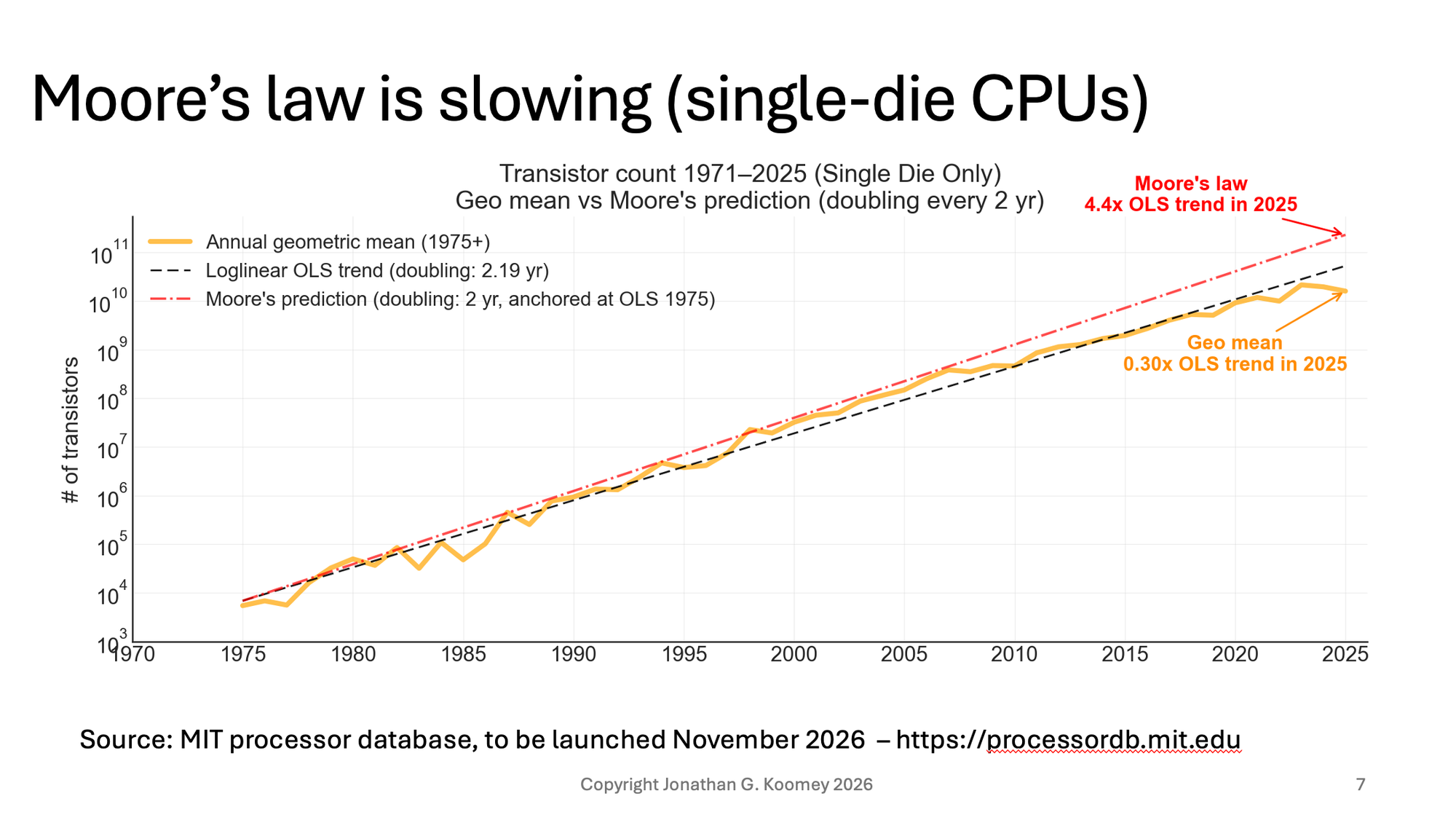
Moore's law is definitely slowing, and we have the data (through 2025) to prove it. Here's the key graph of transistors on a chip for CPUs.
References
Feynman, Richard P. 1992. "There's plenty of room at the bottom [data storage]." Journal of Microelectromechanical Systems. vol. 1, no. 1. pp. 60–66.
Feynman, Richard P. 1993. "Infinitesimal machinery." Journal of Microelectromechanical Systems. vol. 2, no. 1. pp. 4–14.
Feynman, Richard P. 2001. The Pleasure of Finding Things Out: The Best Short Works of Richard P. Feynman. London, UK: Penguin Books.
Leiserson, Charles E., Neil C. Thompson, Joel S. Emer, Bradley C. Kuszmaul, Butler W. Lampson, Daniel Sanchez, and Tao B. Schardl. 2020. "There’s plenty of room at the top: What will drive computer performance after Moore’s law?" Science. vol. 368, no. 6495. pp. eaam9744. [http://science.sciencemag.org/content/368/6495/eaam9744.abstract]
