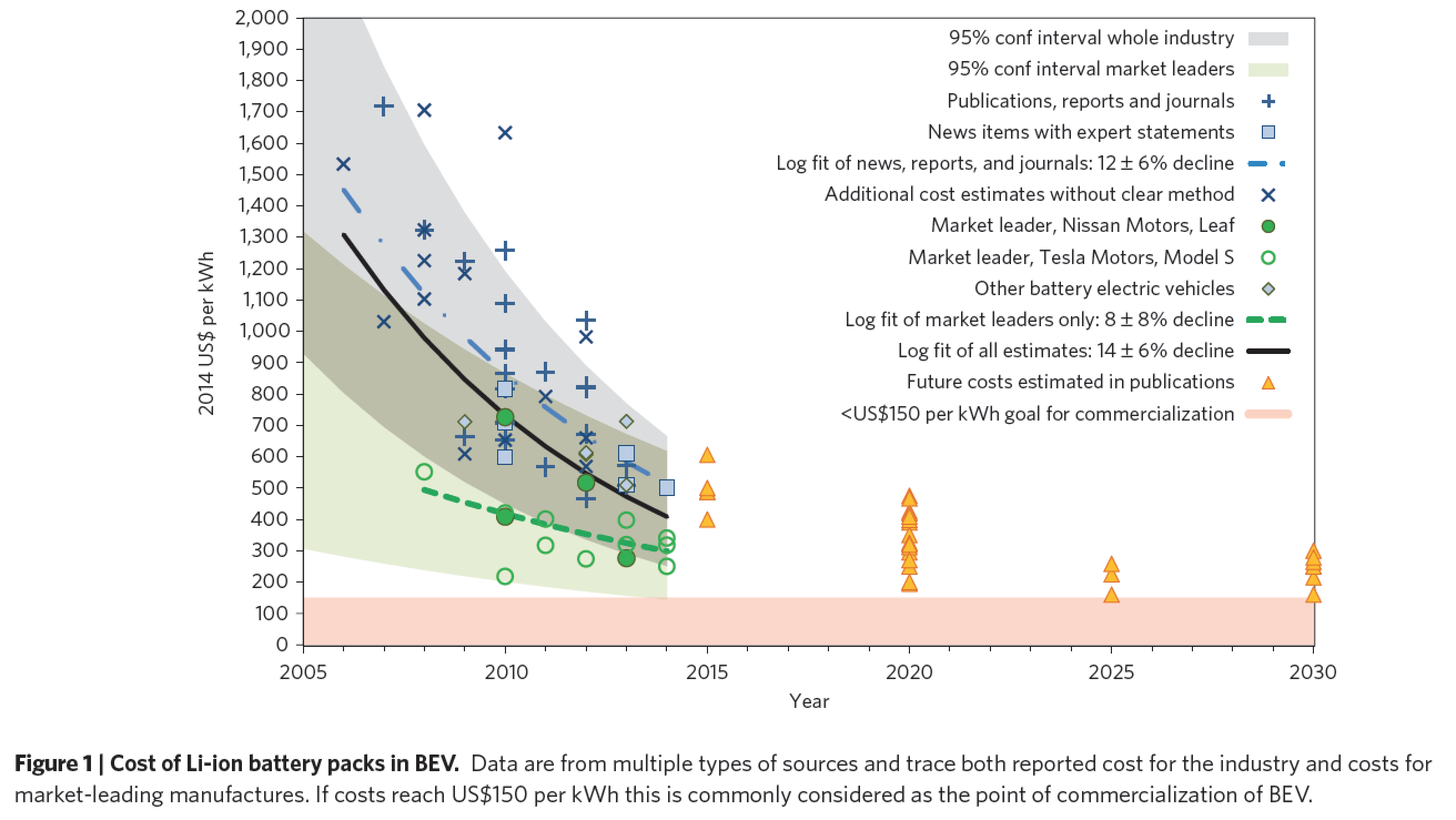
One of the biggest issues affecting the viability of electric vehicles is the cost of battery storage. A new article in Nature Climate Change explores the recent data on the cost of batteries, finding an average rate of decline of about 8% per year since 2006 and a learning rate (the percentage decline in per unit cost per doubling of cumulative production capacity) of between 6 and 9%. With production of such batteries growing rapidly, the decline in costs per unit in the next few years should be substantial.
I’ve reproduced Figure 1 from the article above. There is always a lot of uncertainty with such data, because so much of it is proprietary, but this article does a good job of trying to make those data comparable.
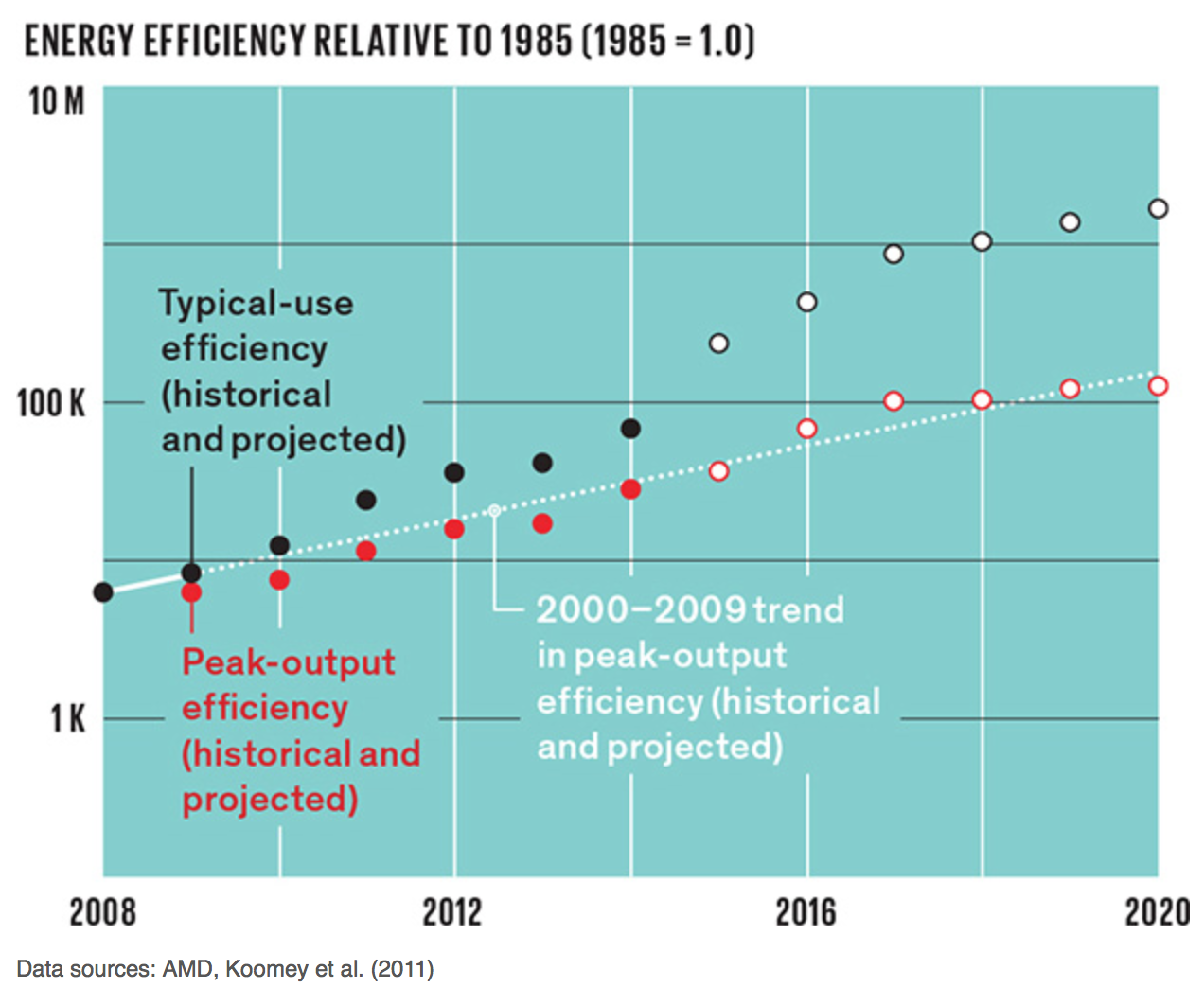
The graph posted above summarizes the main story, which is that peak output efficiency, which doubled every 2.7 years after 2000, is expected to continue on that pace through 2020, based on the AMD processor roadmap. The metric we call “typical-use efficiency”, on the other hand, which takes account of ever lower standby power modes, should see a faster rate of improvement. From 2008 to 2020 the rate of change in typical-use efficiency (according to AMD data) will result in about a doubling of efficiency every 1.5 years, which is similar to that for peak output efficiency in the half century preceding the year 2000.
We’ll have a longer version with more graphs and explanation posted soon.
A colleague of mine at MIT, Noelle Eckley Selin, along with some of her other colleagues, will be offering a 4 day short course on Sustainability: Principles and Practice on July 27-31, 2015.
Here’s the course overview:
This course will introduce participants to the goals, principles, and practical applications of sustainability from science/engineering, policy, and business perspectives. Many organizations, companies, and institutions are increasingly interested in conducting their activities while becoming more sensitive to environmental, social, and other concerns over a longer-term future. Sustainability has many definitions and includes environmental, social, and economic dimensions. In this course, we will examine the major environmental issues and trends happening in modern society from a scientific and practical perspective, including energy and resource use, pollution, climate change, water, and population. Conceptual definitions of sustainability will be introduced and discussed and sustainability plans from organizations and institutions will be examined and critiqued. The course presents practical skills for participants in the area of integrating sustainability into business practices, operations, policies, and research and development through a day of dedicated case studies. The course emphasizes sustainability in all its dimensions, including all “three E’s” of environment, economics, and equity. New research will be presented by faculty working in the area of sustainability science and engineering at MIT.
The class looks like a great intensive introduction to the application of sustainability in business. Check it out!
In perusing this recent post on Skeptical Science, I found a link to a terrific speech by a former UK diplomat (John Ashton) about the oil industry’s position on climate change. He is responding to a speech by Shell CEO Ben van Burden, and it’s really worth a read.
Here are a few key paragraphs:
The summary that accompanies the published text of your speech also catches the eye.
It anticipates an “energy transition”. But it foresees no change “in the longer term” in the drivers of supply and demand for oil. And it urges the industry to “make its voice heard” at the COP21 climate conference. This would add “realism and practicality” to a conversation from which, by implication, these attributes are currently lacking.
In other words, the energy transition to come will be an unusual kind of transition. It will have no structural consequences for the energy system itself, or at least for the markets on which your business model depends.
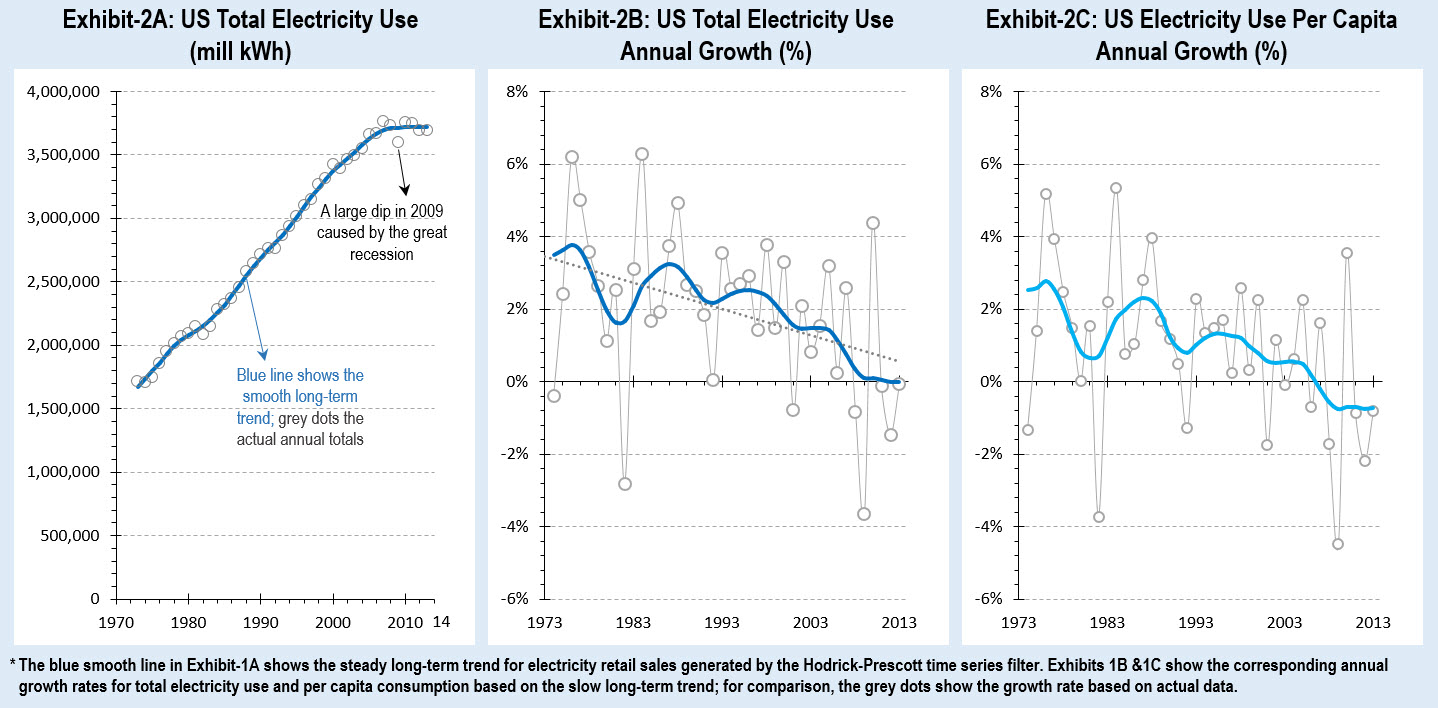
Here is a must read data analysis from my friends at CO2 Scorecard for those interested in what’s happening in the US utility industry. Electricity demand growth has slowed to zero in the past half decade, which is the culmination of long term trends associated with the implementation of efficiency policies, shifting production to less energy intensive industries, off shoring of some manufacturing, and other factors. The implication is that utility profits, which traditionally depend on growing electricity use, will not be rising anytime soon.
Here’s the summary:
We have reached a tipping point in America’s power sector. An industry that has sustained itself on Americans’ growing power demands has suddenly seen demand drop. This is making it difficult for US power utilities, under their current model, to turn a profit. What’s more, this is not a new trend. Using a time-series filter, an analysis of forty years of monthly end-use electricity data exposes a twenty-five year trend during which energy efficiency has steadily chipped away at the total electricity use in the US.
This would signal a pending contraction of the power generation sector, but seasonal, cyclical fluctuations are making it impossible for power providers to scale back. Increasingly warm summers in the US, combined with a demographic shift towards warmer states, have caused demand for electricity to actually increase during peak seasons.
The two diverging long-term patterns—falling electricity use and the increasing peak load—create a perfect storm for the finances of utility companies. While warmer summers require utilities to maintain generation capacity, warmer winters and energy efficiency starkly reduce demand the rest of the year, cutting into utility companies’ cash flow and bottom line.
This may be good news for consumers who watch their electricity bills drop, but it’s a real problem for power companies. If trends persist, they will be forced to increase the price of electricity to cover costs. But increased price will only strengthen the incentives for more electricity conservation and boost the demand for rooftop solar with net metering.
We see this action-and-reaction as a disruptive force that could trigger radical reform of the power sector’s obsolete business model.
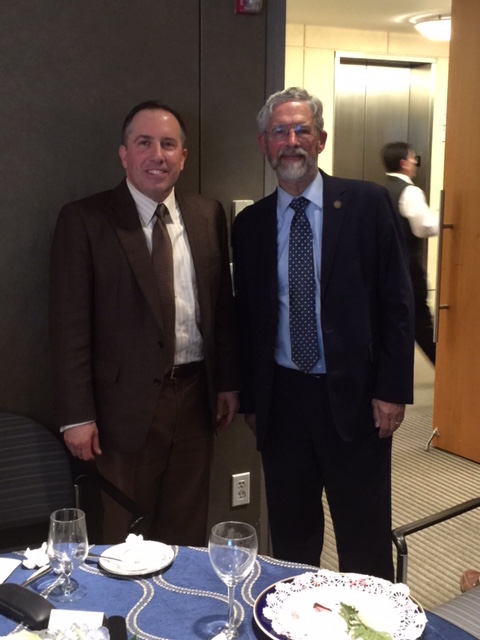
Me and John Holdren, March 10, 2015 (I should have fixed my tie!)
The professor who had the most influence on me as a graduate student at UC Berkeley (after my main thesis advisors Art Rosenfeld and Tony Fisher) was John P. Holdren, who now heads up the President’s Office of Science and Technology Policy (OSTP). In 2008, he was good enough to write the forward to the 2nd edition of my book Turning Numbers into Knowledge, which you can download here.
John graciously accepted an invitation from me and Jessica Matthews at Carnegie to keynote the VIP dinner that occurred on March 10, 2015, the night before we unveiled the Oil Climate Index. John’s summary of the climate problem and key policy implications is second to none, and I wanted to share his talk. It will be posted to the OSTP and Carnegie web sites soon, but since I can move a bit faster, I posted it below.
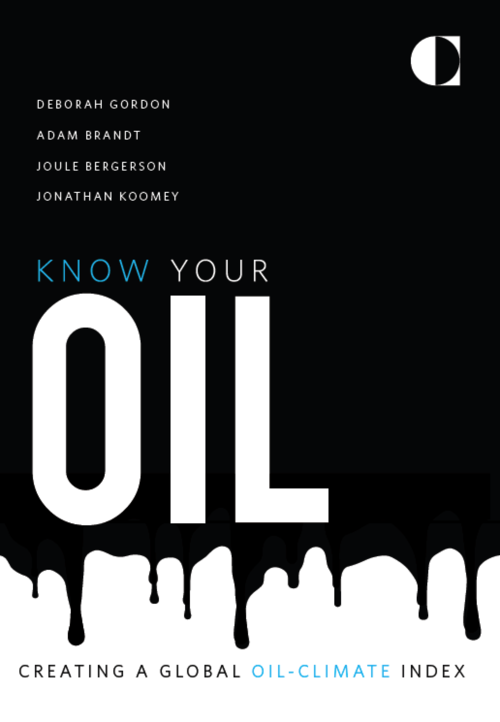
My coauthors and I just released the initial report about our Oil Climate Index (OCI), which estimates using public data and open source models the total lifecycle greenhouse gas (GHG) emissions from different oils. Where the oil is discovered, how it is extracted, how it is transported, and how it is refined all make a huge difference in total GHG emissions. In our initial set of 30 oils, we found that the highest emissions oil had 80% higher emissions than the lowest emissions oil.
That difference is big enough to matter, and that means investors and oil companies can affect their greenhouse gas emissions by the choices they make.
Here are the key “next steps” that emerged from the report:
The second phase of the OCI, which will be finished this summer (2015), will result in an additional 20 oils being added to the analysis, for a total of 50 oils from all over the world.
Here’s the full reference:
Gordon, Deborah, Adam Brandt, Joule Bergeson, and Jonathan Koomey. 2015. Know Your Oil: Creating a Global Oil-Climate Index. Washington, DC: Carnegie Endowment for International Peace. March 11. [http://goo.gl/Jly9Op]
I spoke with Tech Nation host Moira Gunn about my book Cold Cash, Cool Climate: Science-based Advice for Ecological Entrepreneurs back in May 2012, and have finally gotten access to the recording so I can post it (it’s accessible via a Creative Commons license, but I had difficulties linking to it on the Tech Nation web site). I was very happy with the interview, in which I explained why I think the climate problem is big, urgent and misunderstood, and why entrepreneurs are key to solving the problem. At about 29 minutes in I talk about the Clean Web movement and why it’s a great example of entrepreneurial innovation. Moira is great at drawing out key themes in complex technical topics, and I had a lot of fun chatting with her.
Update: This class was originally scheduled for March 9th, 2015, but we haven’t met our student signup goals, so we’re postponing the class to Sept 14th 2015, and revisiting our marketing strategy. Please email me with any questions.
I’ve been struggling for years to convince executives in large enterprises to fix the incentive, reporting, and other structural problems in data centers. The folks in the data center know that there are issues (like having separate budgets for IT and facilities) but fixing those problems is “above their pay grade”. That’s why we’ve been studying the clever things eBay has done to change their organization to take maximal advantage of IT, as summarized in this case study from Fall 2013:
That’s also why I’ve worked with Heatspring to develop the following course, which I’ll be giving for the 2nd time (with a slightly modified title) starting next week:
I’m excited about this class, but need more signups. Please spread the word by alerting upper level management in the company where you work. You can use this shortened link to the course page for convenience: http://goo.gl/K4kJG2
Addendum: I’ve just learned that Professor Pielke has apparently retired from the world of Climate Policy, on the same day that our response was posted. The timing is no doubt a coincidence, but it may mean that we won’t hear back from him about our request. Someone posted a link to our response on his final blog posting. We’ll see if he responds.
Oil is changing. Tight shale oil, oil sands, heavy oils, ultra-deep oils, depleting oils, oil shale, and an expanding array of hydrocarbons are vying for market share. Consumers may not notice the transformation—aside from recent price fluctuations, little appears to have changed at the gas pump. But behind-the-scenes, the oils themselves, how they are extracted and processed, and the products into which they are made, are shifting in substantial ways.
These changes raise important questions: What are the characteristics and properties of these oils? How do they compare to one another in terms of their climate impacts?
The Carnegie Endowment for International Peace, Stanford University, and the University of Calgary have developed the first-of-its-kind Oil-Climate Index, modeling these complex interactions. These open source data and models will shape how consumers, investors, industries, NGOs, and policymakers approach current and future oil production, refining, and consumption.
I worked on this project with my colleagues Deborah Gordon (Carnegie Endowment for International Peace), Joule Bergerson (University of Calgary), and Adam Brandt (Stanford University).
Here are the details on the upcoming event:
Oil-Climate Index Release Event
You can get more details at this link. Let me know if you’d like to attend!
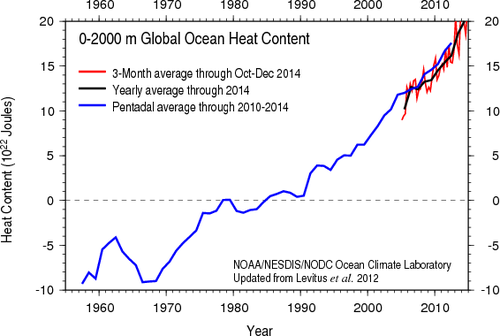
John Abraham has a summary post on the Guardian website describing the recent data on ocean temperatures, and it’s a doozy. Here’s the graph of ocean heat content since before 1960, and it shows substantial increases since 1990.
About 90% of recent warming is stored in the oceans, so this result is consistent with the well established scientific fact that the earth has warmed substantially in recent decades.
Abraham sums it all up nicely:
So when we look back on 2014 and the records that fell, it gives us some pause about the so-called pause (hat-tip to Dr. Greg Laden for that phrase). Some people tried to tell us global warming had “paused”, that it ended in 1998, or that the past 15 years or so had not seen a change in the energy of the Earth. This ocean warming data is the clearest nail in that coffin. There never was a pause to global warming, there never was a halt, and the folks that tried to tell you there was were, well, I’ll let you decide. For me, the facts speak for themselves.
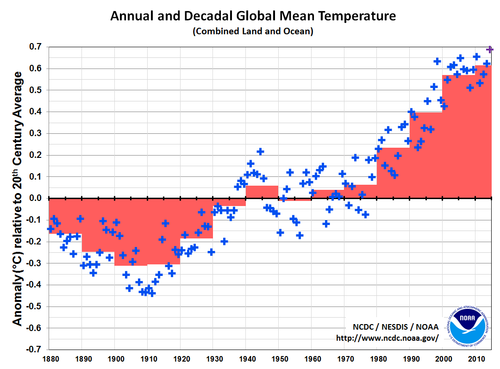
I hope this development finally puts to rest the incorrect notion that there’s been a pause (Professor Michael Mann calls it a “faux pause”) in global warming. That result is made clear in the graph below, which shows decadal average temperatures since 1880.
The 1980s were the hottest decade on record. Then came the 1990s, which became the hottest, and then the 2000s were the hottest. Now we’re on track for the 2010s to be the hottest decade on record. If the averages keep going up, the temperature has to be increasing over time. It’s just math.
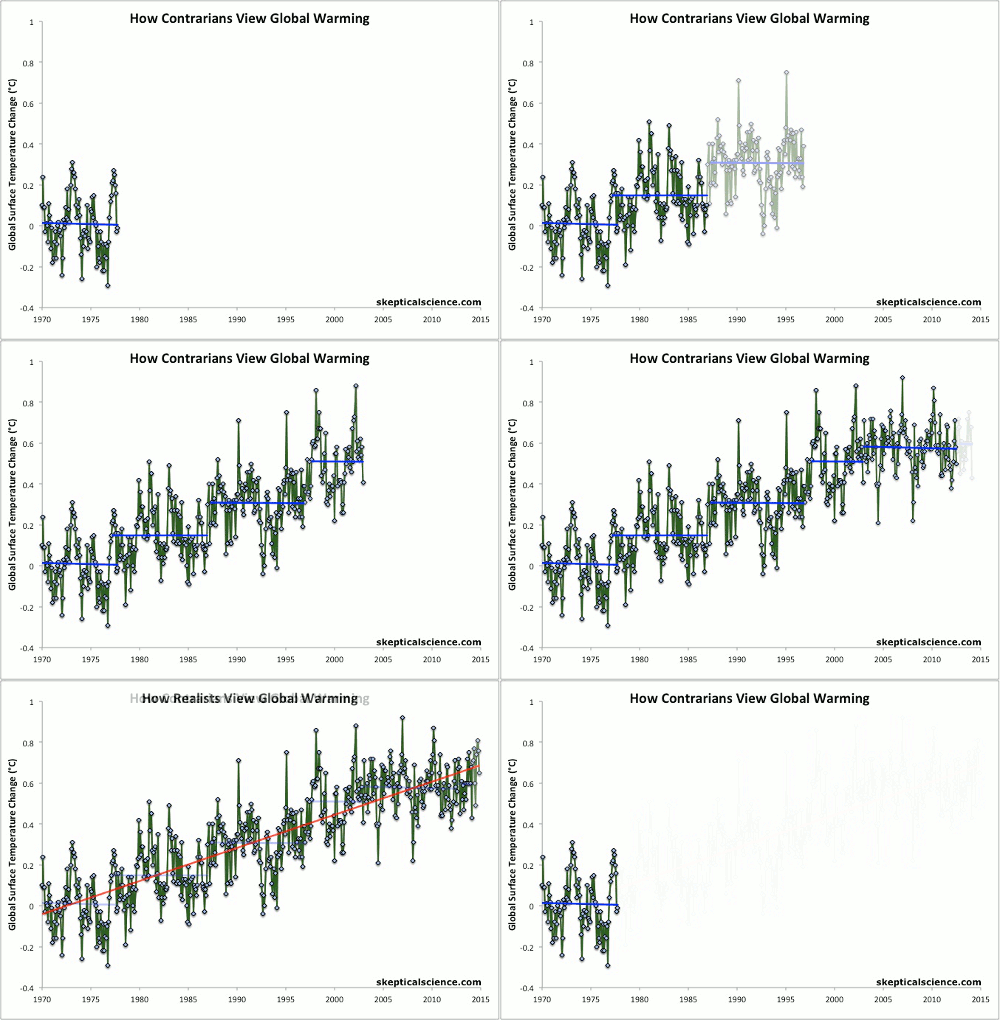
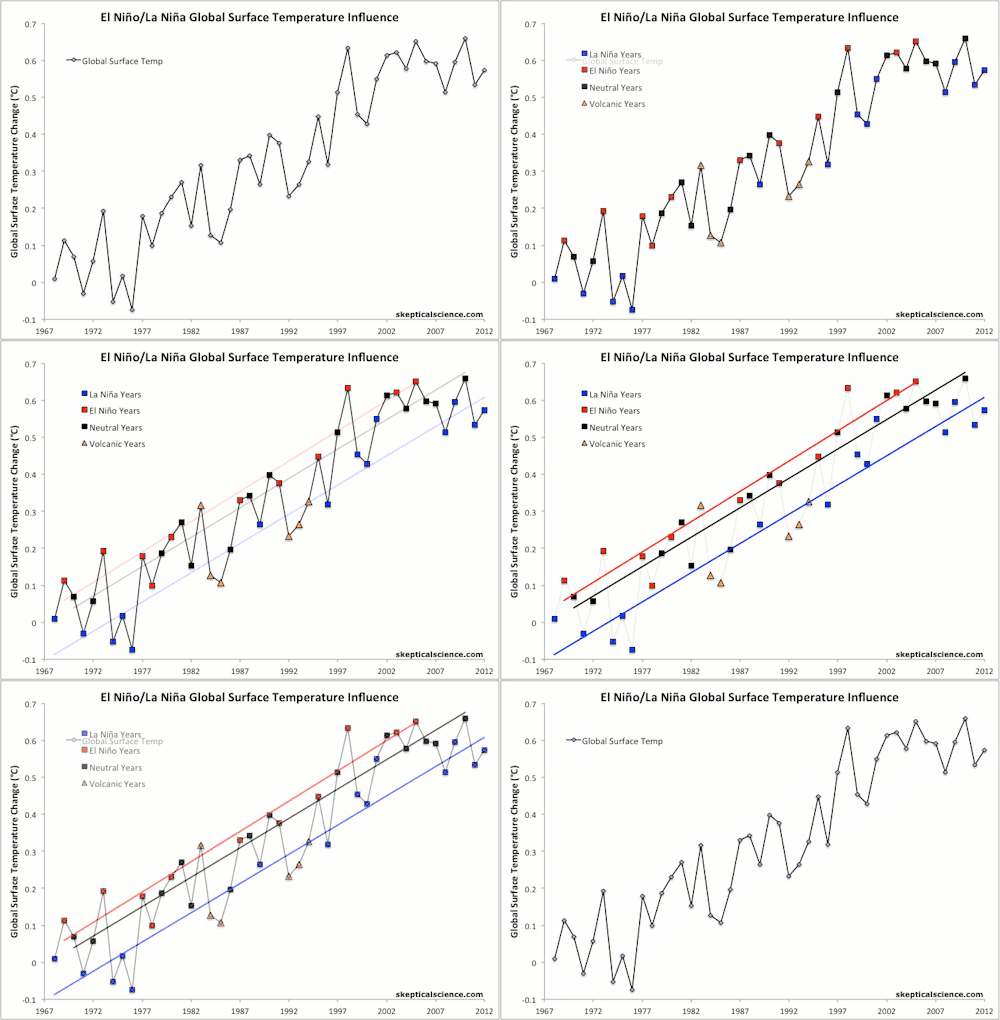
The reason why some observers argued that global warming was slowing down is because of cherry picking of data. The year 1998 was an exceptionally hot year, because it was a record El Nino year, but those arguing for a pause deliberately chose that year as the basis for their argument.
The website Skeptical Science shows the climate escalator, contrasting the way cherry pickers view the data and the way realists view the data. Those graphs are embodied in the GIF below.
The critical thing about 2014 is that we don’t yet have an El Nino (although one may be declared in 2015). When you separate the El Nino, la Nina, and neutral years, the warming trend becomes crystal clear (Graph courtesy of Skeptical Science).
It’s also important to understand that the climate varies over time, and that even a decade of data isn’t enough to determine a true trend. We now have more than 4 decades of data (starting in the 1970s) that is consistent with a rapidly warming earth, driven by emissions of greenhouse gas emissions and other human induced changes. It’s therefore time for contrarians to give up the idea that climate hasn’t warmed since 1998. Global warming, driven by human activities, continues unabated.
My friends at Climate Nexus, who successfully pitched the article, say this is excellent pickup for an oped like this (and a few more papers may follow in the next day or two). Philip Newell and Dianne Saenz were also helpful in guiding the article towards the right focus (on how we get out of this hole we’ve dug ourselves into).
Here’s the oped, along with the footnotes supporting the claims I make there. The opeds themselves as published don’t have the footnotes of course, but having them online may be useful to some who want to dig into my conclusions.
The Intergovernmental Panel on Climate Change (IPCC) just released its Fifth Assessment Report, summarizing the state of climate science and solutions. The report reinforces previous findings that the earth is warming, humans are primarily responsible, and rapid reductions in emissions are urgently needed.[i] Our current emissions trend increases substantially the risk of costly, dangerous, irreversible, and potentially catastrophic changes in the global life support systems upon which we all depend.
We’ve dug ourselves into a deep climate hole. Despite ever more dire warnings, greenhouse gas (GHG) emissions have grown 42% since the IPCC’s first assessment report in 1990.[ii] Preserving a safe climate means turning global GHG emissions down this decade and reducing them rapidly in absolute terms over the next 40 years, even as GDP and population increase.[iii] It also means keeping three quarters of proved reserves of fossil fuels in the ground, or safely storing the emissions from burning those fuels.[iv]
The science summarized by the IPCC gives clear guidance for what to do next:
Stop new digging. The more high-emissions infrastructure we build now, the more we’ll have to scrap in coming decades,[v] so let’s stop building it as soon as we can. That means no new coal-fired power plants, no new shipping terminals to move coal overseas, no more pipelines or rail lines to unconventional oil supplies, and no drilling for oil in the soon-to-be ice-free Arctic. It will be difficult to stop these projects, but once built, they will be even harder to shut down. Better to not build them in the first place.
Charge the full cost of digging. To stabilize the climate, we need policies consistent with a low emissions world (like those now in place in California), including prices on greenhouse gas emissions and other pollutants, as well as vigorous enforcement of existing and even stricter safety and environmental regulations. That also means ditching the “all of the above” energy strategy in the US, where fossil fuels are supported on a coequal basis with non-fossil sources of energy.[vi] Subsidies for fossil fuels need to disappear.[vii] Mountaintop removal coal mining[viii] and single-bid auctions of fossil fuels on public lands[ix] need to stop. And bonding requirements for US natural gas drilling companies, last set in 1960 and never adjusted for inflation, need to increase substantially.[x]
Climb out with alternatives. Existing clean energy technologies already offer many opportunities in both developed and developing economies, and costs are dropping fast. Wind generation is now competitive with conventional sources[xi], even without counting the latter’s pollution costs[xii], and solar is not far behind[xiii]. Deploying distributed renewable electricity in microgrids is often cheaper than extending the central electric grid in the developing world.[xiv] Energy efficiency remains the cheapest, cleanest, fastest emissions reduction resource, with innovation (especially in information technologies[xv]) delivering more and better efficiency options with each passing day.[xvi] Retrofitting existing hydro facilities is simple and cost effective.[xvii] Cogeneration of heat and power remains underused.[xviii] And if the nuclear industry can build plants as quickly, as cheaply, and as safely as they say they can, that technology might also help.[xix]
Surviving this stage of human development means we’ll need to evolve as a species to learn how to face challenges like this one, trying many things, failing fast, and doing more of what works and less of what doesn’t. We’ll need to foster rapid innovation, fierce competition, and active coordination, all at the same time. We’ll also need to reassess our responsibilities to each other, to the earth, and to future generations. And we’ll need to explore innovations in our values, our behaviors, and our institutions, which can be as powerful as those for new technologies in opening up possibilities for the future.
Today’s technology now allows us to move past combustion in most applications, but scaling it up to meet the demands of a modern industrial society won’t be easy. Of course, not doing so will be harder still, because of the damages unrestricted climate change will inflict on the earth and on human society.[xx]
The new IPCC Synthesis Report shows how to climb out of this hole. But first we need to stop digging.
[iii] Koomey, Jonathan G. 2012. Cold Cash, Cool Climate: Science-Based Advice for Ecological Entrepreneurs. Burlingame, CA: Analytics Press. [http://www.analyticspress.com/cccc.html]
[iv] Koomey, Jonathan G. 2012. Cold Cash, Cool Climate: Science-Based Advice for Ecological Entrepreneurs. Burlingame, CA: Analytics Press. [http://www.analyticspress.com/cccc.html]
McKibben, Bill. 2012. “Global Warming’s Terrifying New Math.” In Rolling Stone Magazine. July 19. pp. [http://www.rollingstone.com/politics/news/global-warmings-terrifying-new-math-20120719]
Gore, Al, and David Blood. 2013. “The Coming Carbon Asset Bubble.” The Wall Street Journal (online). October 29. [http://online.wsj.com/news/articles/SB10001424052702304655104579163663464339836?mod=hp_opinion]
[v] Steven, J. Davis, and H. Socolow Robert. 2014. “Commitment accounting of CO 2 emissions." Environmental Research Letters. vol. 9, no. 8. pp. 084018. [http://stacks.iop.org/1748-9326/9/i=8/a=084018]
Luderer, Gunnar, Robert C. Pietzcker, Christoph Bertram, Elmar Kriegler, Malte Meinshausen, and Ottmar Edenhofer. 2013. "Economic mitigation challenges: how further delay closes the door for achieving climate targets." Environmental Research Letters. vol. 8, no. 3. September 17. [http://iopscience.iop.org/1748-9326/8/3/034033/article]
Koomey, Jonathan G. 2012. Cold Cash, Cool Climate: Science-Based Advice for Ecological Entrepreneurs. Burlingame, CA: Analytics Press. [http://www.analyticspress.com/cccc.html]
[x] Davis, Lucas. 2012. Modernizing Bonding Requirements for Natural Gas Producers. The Hamilton Project. Discussion Paper 2012-02. June. [http://www.hamiltonproject.org/files/downloads_and_links/06_bonds_davis.pdf]
[xii] Muller, Nicholas Z., Robert Mendelsohn, and William Nordhaus. 2011. "Environmental Accounting for Pollution in the United States Economy." American Economic Review vol. 101, no. 5. August. pp. 1649–1675. [https://www.aeaweb.org/articles.php?doi=10.1257/aer.101.5.1649]
Epstein, Paul R., Jonathan J. Buonocore, Kevin Eckerle, Michael Hendryx, Benjamin M. Stout Iii, Richard Heinberg, Richard W. Clapp, Beverly May, Nancy L. Reinhart, Melissa M. Ahern, Samir K. Doshi, and Leslie Glustrom. 2011. "Full cost accounting for the life cycle of coal." Annals of the New York Academy of Sciences. vol. 1219, no. 1. February 17. pp. 73-98. [http://dx.doi.org/10.1111/j.1749-6632.2010.05890.x]
[xv] Koomey, Jonathan. 2012. "The Computing Trend that Will Change Everything.” In Technology Review. May/June. pp. 76-77. [http://www.technologyreview.com/news/427444/the-computing-trend-that-will-change-everything/]
Lovins, Amory B., Mathias Bell, Lionel Bony, Albert Chan, Stephen Doig, Nathan J. Glasgow, Lena Hansen, Virginia Lacy, Eric Maurer, Jesse Morris, James Newcomb, Greg Rucks, and Caroline Traube. 2011. Reinventing Fire: Bold Business Solutions for the New Energy Era. White River Junction, VT: Chelsea Green Publishing. [http://www.rmi.org/ReinventingFire]
[xix] Koomey, Jonathan, and Nathan Hultman. 2009. The Real Risk of Nuclear Power. Washington, DC: The Brookings Institution. December 2. [http://www.brookings.edu/opinions/2009/1202_nuclear_power_hultman.aspx]
Koomey, Jonathan G., and Nathan E. Hultman. 2007. “A reactor-level analysis of busbar costs for U.S. nuclear plants, 1970-2005." Energy Policy. vol. 35, no. 11. November. pp. 5630-5642. [http://dx.doi.org/10.1016/j.enpol.2007.06.005]
For those interested in digging in, I found the longer Victor response to be clearer than the very condensed Nature article. The Roberts response is the easiest read for those who are less technical, while the Romm, Hare, and Rahmstorf pieces go into a lot more detail about the problems with the Nature article, which are many and varied.
I’m not going to get into a blow-by-blow analysis of the discussion. Instead, I’d like to explore some key aspects of the 2 C limit that Victor (and others) seem to misunderstand, because of the importance of this concept to making the case for urgent action on climate.
Let me begin by saying that Victor is an acquaintance of mine from when he worked at Stanford, and I’ve always been impressed by his keen intellect. I invited him to lecture in my class when I was first a visiting professor there in 2003-4. He also graduated from Harvard with an undergraduate degree in History and Science, as did I, so I have a deep understanding of his early training. I would call him a friend, though not a close one. But that doesn’t mean I agree with the arguments he made about abandoning the 2 C limit.
The 2 C warming limit is more than just a number (or a goal to be agreed on in international negotiations). It embodies a way of thinking about the climate problem that yields real insights [2]. The warming limit approach, which can also be described as “working forward toward a goal”, involves assessing the cost effectiveness of different paths for meeting a normatively-determined target. It has its origins in the realization that stabilizing the climate at a certain temperature (e.g., a warming limit of 2 Celsius degrees above pre-industrial times) implies a particular emissions budget, which represents the total cumulative greenhouse gas emissions compatible with that temperature goal. That budget also implies a set of emissions pathways that are well defined and tightly constrained (particularly now that we’ve squandered the past two decades by not reducing emissions).
The 2 C limit is a value choice that is informed by science. It should not be presented as solely a scientific “finding”, but as a value judgment that reflects our assessment of societal risks and our preferences for addressing them.
The warming limit approach had its first fully-developed incarnation in 1989 in Krause et al. [3] (which was subsequently republished by Wiley in 1992 [4]). It was developed further in Caldeira et al. [5] and Meinshausen et al. [6], and has recently served as the basis for the International Energy Agency’s analysis of climate options for several years running [7, 8, 9].
Such an approach has many advantages. It encapsulates our knowledge from the latest climate models on how cumulative emissions affect global temperatures, placing the focus squarely on how to stabilize those temperatures. It places the most important value judgment up-front, embodied in the normatively determined warming limit, instead of burying key value judgments in economic model parameters or in ostensibly scientifically chosen concepts such as the discount rate. It gives clear guidance for the rate of emissions reductions required to meet the chosen warming limit, thus allowing us to determine if we’re “on track” for meeting the ultimate goal, and allowing us to adjust course if we’re not hitting those near-term targets. It also allows us to estimate the costs of delaying action or excluding certain mitigation options, and provides an analytical basis for discussions about equitably allocating the emissions budget. Finally, instead of pretending that we can calculate an “optimal” technology path based on guesses at mitigation and damage cost curves decades hence, it relegates economic analysis to the important but less grandiose role of comparing the cost effectiveness of currently available options for meeting near-term emissions goals [2].
The warming limit approach shows that delaying action is costly, required emissions reductions are rapid, and most proved reserves of fossil fuels will need to stay in the ground if we’re to stabilize the climate. These ideas may not be news to some, but many don’t realize that they follow directly from the warming limit framing.
• Delaying emissions reductions forecloses options and makes achieving climate stabilization much more difficult [10]. “Wait and see” for the climate problem (or for new metrics characterizing it) is foolish and irresponsible, which is obvious when considering cumulative emissions under a warming limit. The more fossil infrastructure you build now, the faster we’ll have to reduce emissions later. If energy technologies changed as fast as computers there could be justification for “wait and see” in some circumstances, but they don’t, so it’s a moot point.
• Global emissions will need to turn down this decade and approach zero in the next three to four decades if we’re to have a two thirds change of staying under the 2 C limit [11]. The emissions pathways given the current carbon budgets are tightly constrained. Even if the climate sensitivity is at the lowest end of the range included in IPCC reports (1.5 C), that only buys us another decade in the time of emissions peak [12], which indicates that the findings on emissions pathways are robust, even in the face of large variations in climate sensitivity.
• The rate of emissions reductions, which is a number that can be measured, is one way to assess whether the world is on track to meet the requirements of the 2 C limit. We know what we need to be doing to succeed, and if we don’t meet the tight time constraints imposed by that cumulative emissions budget in one year, we need to do more the next year, and the next, and the next. It’s a way of holding policy makers’ proverbial feet to the fire.
ª The concept of “stranded fossil fuel assets” that can’t be burned, popularized by Bill McKibben [13] and Al Gore [14], follows directly from the warming limit framing. In fact, our 1989 book, Energy Policy in the Greenhouse [3] (which Victor reviewed in a cursory way for Nature in 1990, ironically enough), had a chapter titled “How much fossil fuel can still be burned?”. So the idea of stranded assets is not a new insight (but it is a profound one).
Victor also expresses strong views of how international agreements come about, based on his extensive study of historical developments in this area. It is likely, however, that an unprecedented challenge will require us to create international agreements in ways different from how we’ve done things in the past. We aren’t necessarily constrained by history, and in fact modifying institutional arrangements (like property rights and international agreements) is one of the most important ways to speed up our rate of innovation to meet this challenge.
The possibility of such institutional changes is ignored by assumption in the economic modeling exercises cited by Victor in his longer essay. For this and many other reasons, economic models tend to underestimate the possibilities for change and make alternative futures seem more expensive and difficult than they will be to achieve in reality [11]. Victor seems to believe the exact opposite, that the models are too optimistic about the possibilities for change. In support of his belief he cites a few examples of technologies with limited current application that dominate the modeling results, but does not mention the large literature indicating the inherent pessimism of such modeling exercises. These models usually ignore the possibilities for energy efficiency improvements, for increasing returns to scale and learning effects, for path dependence, for changes in institutional and individual behavior, and for new mass produced technologies to achieve significant cost reductions [15, 16, 17, 18, 19, 20, 21].
I do think the Victor and Kennel piece in Nature contributes something useful to the discussion, in the form of alternative metrics to supplement the 2 C limit. But there’s no reason to abandon one of the few bright spots in the entire climate agenda because two researchers have a rather narrow idea of how international agreements should be negotiated. Alternative metrics are useful and important, but they are a supplement, adding additional degrees of freedom to the negotiations. They cannot replace the 2 C limit, nor should they.
The warming limit approach is the most powerful analytical way of thinking about the climate problem that the climate science and policy community has yet devised. So the answer is not to “ditch the 2 C limit”, but to use it to show (in Victor and Kennel’s words) that “politicians …pretend that they are organizing for action when, in fact, most have done little.”
The warming limit framing makes it abundantly clear that emissions reductions efforts to date are inadequate to meet the stated goal (see the discussion of “stranded assets” by McKibben [13] and Gore [14] for concrete evidence of this reality). However, this failing is not the fault of the 2 C limit or the mode of analysis it enables, as Victor and Kennel imply. Instead, it is the fault of those who allow this charade to continue. The answer is therefore not to abandon this way of thinking about the climate problem, but to use it to argue for rapid and measurable reductions, starting now, and to expose as charlatans those who claim to be concerned about climate disruption but are unwilling to do what it takes to avoid it. There is nothing better than the 2 C limit for making that case.
The Victor and Kennel article assumes that the 2 C limit is the cause of global inaction on emissions reductions, and that developing a new framework and associated metrics can somehow break the logjam. I suggest instead that the lack of progress is in spite of the power of the warming limit framing, and that it owes more to the challenge of global elites confronting powerful corporations and countries who face the prospect of trillions of dollars in stranded assets and are fighting like hell to avoid that outcome.
The alternative to facing this difficult political challenge is allowing emissions trends to continue that will make the orderly development of human civilization as we have known it all but impossible by the end of this century. A stark choice, but we will either reduce our emissions rapidly (which will require big changes in how society operates) or our current path will force upon us bigger (and far less manageable) changes. That’s the reality that the warming limit framing makes clear, and ditching the warming limit won’t change that reality.
Corrigendum: The earlier posted version of this post incorrectly attributed the Real Climate article to Stephen Landowsky. The actual author was Stefan Rahmstorf . My apologies to Stephan and Stefan for the misattribution.
References
1. Victor, David G., and Charles F. Kennel. 2014. “Climate policy: Ditch the 2 °C warming goal.” Nature. vol. 514, no. 7520. October 2. pp. 30-31. [http://www.nature.com/news/climate-policy-ditch-the-2-c-warming-goal-1.16018]
2. Koomey, Jonathan. 2013. “Moving Beyond Benefit-Cost Analysis of Climate Change.” Environmental Research Letters. vol. 8, no. 041005. December 2. [http://iopscience.iop.org/1748-9326/8/4/041005/]
3. Krause, Florentin, Wilfred Bach, and Jon Koomey. 1989. From Warming Fate to Warming Limit: Benchmarks to a Global Climate Convention. El Cerrito, CA: International Project for Sustainable Energy Paths. [http://www.mediafire.com/file/pzwrsyo1j89axzd/Warmingfatetowarminglimitbook.pdf]
4. Krause, Florentin, Wilfred Bach, and Jonathan G. Koomey. 1992. Energy Policy in the Greenhouse. NY, NY: John Wiley and Sons. [http://amzn.to/1z5CDIl]
5. Caldeira, Ken, Atul K. Jain, and Martin I. Hoffert. 2003. “Climate Sensitivity Uncertainty and the Need for Energy Without CO2 Emission “ Science. vol. 299, no. 5615. pp. 2052-2054. [http://www.sciencemag.org/cgi/content/abstract/299/5615/2052]
6. Meinshausen, Malte, Nicolai Meinshausen, William Hare, Sarah C. B. Raper, Katja Frieler, Reto Knutti, David J. Frame, and Myles R. Allen. 2009. “Greenhouse-gas emission targets for limiting global warming to 2 degrees C.” Nature. vol. 458, April 30. pp. 1158-1162. [http://www.nature.com/nature/journal/v458/n7242/full/nature08017.html]
7. IEA. 2010. World Energy Outlook 2010. Paris, France: International Energy Agency, Organization for Economic Cooperation and Development (OECD). November 9. [http://www.worldenergyoutlook.org/]
8. IEA. 2011. World Energy Outlook 2011. Paris, France: International Energy Agency, Organization for Economic Cooperation and Development (OECD). November 9. [http://www.worldenergyoutlook.org/]
9. IEA. 2012. World Energy Outlook 2012. Paris, France: International Energy Agency, Organization for Economic Cooperation and Development (OECD). November 12. [http://www.worldenergyoutlook.org/]
10. Luderer, Gunnar, Robert C. Pietzcker, Christoph Bertram, Elmar Kriegler, Malte Meinshausen, and Ottmar Edenhofer. 2013. “Economic mitigation challenges: how further delay closes the door for achieving climate targets.” Environmental Research Letters. vol. 8, no. 3. September 17. [http://iopscience.iop.org/1748-9326/8/3/034033/article]
11. Koomey, Jonathan G. 2012. Cold Cash, Cool Climate: Science-Based Advice for Ecological Entrepreneurs. Burlingame, CA: Analytics Press. [http://www.analyticspress.com/cccc.html]
12. Joeri, Rogelj, Meinshausen Malte, Sedláček Jan, and Knutti Reto. 2014. “Implications of potentially lower climate sensitivity on climate projections and policy.” Environmental Research Letters. vol. 9, no. 3. pp. 031003. [http://stacks.iop.org/1748-9326/9/i=3/a=031003]
13. McKibben, Bill. 2012. “Global Warming’s Terrifying New Math.” In Rolling Stone Magazine. July 19. pp. [http://www.rollingstone.com/politics/news/global-warmings-terrifying-new-math-20120719]
14. Gore, Al, and David Blood. 2013. “The Coming Carbon Asset Bubble.” The Wall Street Journal (online). October 29. [http://online.wsj.com/news/articles/SB10001424052702304655104579163663464339836?mod=hp_opinion]
15. Ackerman, Frank , Stephen J. DeCanio, Richard B. Howarth, and Kristen Sheeran. 2009. “Limitations of Integrated Assessment Models of Climate Change.” Climatic Change. vol. 95, no. 3-4. August. pp. 297-315. [http://link.springer.com/article/10.1007%2Fs10584-009-9570-x]
16. Ackerman, Frank, Elizabeth A. Stanton, Stephen J. DeCanio, Eban Goodstein, Richard B. Howarth, Richard B. Norgaard, Catherine S. Norman, and Kristen A. Sheeran. 2009. The Economics of 350: The Benefits and Costs of Climate Stabilization. Portland, OR: Economics for Equity and Environment. October. [http://www.e3network.org/papers/Economics_of_350.pdf]
17. DeCanio, Stephen J. 2003. Economic Models of Climate Change: A Critique. Basingstoke, UK: Palgrave-Macmillan. [http://amzn.to/1wvkvDu]
18. Laitner, John A. “Skip”, Stephen J. Decanio, Jonathan G. Koomey, and Alan H. Sanstad. 2003. “Room for Improvement: Increasing the Value of Energy Modeling for Policy Analysis.” Utilities Policy (also LBNL-50627). vol. 11, no. 2. June. pp. 87-94. [http://www.sciencedirect.com/science/article/pii/S0957178703000201]
19. Koomey, Jonathan. 2002. “From My Perspective: Avoiding “The Big Mistake” in Forecasting Technology Adoption.” Technological Forecasting and Social Change. vol. 69, no. 5. June. pp. 511-518. [http://enduse.lbl.gov/Info/LBNL-45383.pdf]
20. Scher, Irene, and Jonathan G. Koomey. 2011. “Is Accurate Forecasting of Economic Systems Possible?” Climatic Change. vol. 104, no. 3-4. February. pp. 473-479. [http://link.springer.com/article/10.1007%2Fs10584-010-9945-z]
21. Krause, Florentin, Paul Baer, and Stephen DeCanio. 2001. Cutting Carbon Emissions at a Profit: Opportunities for the U.S. El Cerrito, CA: International Project for Sustainable Energy Paths. May. [http://www.mediafire.com/file/0aro7bj2d7kqk8w/ipsepcutcarbon_us.pdf]